
Quick AnswerClean a dryer vent once a year, or every six months if you run more than about eight loads a week or vent through a long duct run. The US Fire Administration attributes 34 per cent of residential clothes dryer fires to failure to clean — the single largest contributing factor — across an estimated 2,900 such fires a year. Duct length matters as much as frequency: the residential code caps developed length at 35 feet, minus 5 feet for every 90-degree bend.
Dryer vent cleaning is the service homeowners defer longest, partly because nothing obviously breaks. The failure mode is gradual restriction, and the numbers behind why it matters are more specific than most advice admits.
How Often Should a Dryer Vent Be Cleaned?
Annually is the baseline for an average household. The interval shortens with volume and duct complexity rather than with the age of the dryer.
| Situation | Suggested interval |
|---|---|
| Average household, short straight duct run | Every 12 months |
| More than about 8 loads per week | Every 6 months |
| Duct run over 25 feet or three or more bends | Every 6 months |
| Flexible foil or plastic transition duct | Every 6 months, and replace with rigid metal |
| Regularly drying pet bedding or heavy linens | Every 6 months |
| Any of the warning signs below | Now |
What Actually Causes Dryer Fires?
Lint, and the failure to remove it. The US Fire Administration’s analysis of residential building fires found that failure to clean accounted for 34 per cent of clothes dryer fires and 72 per cent of the operational-deficiency category. An estimated 2,900 such fires are reported to US fire departments each year, causing 5 deaths, 100 injuries and $35 million in property loss. 82.6 per cent started in the laundry area.
The mechanism is simple. Lint is highly combustible, and a restricted duct traps heat that would otherwise leave the house. A dryer that cannot exhaust properly cycles its heating element longer and hotter against a fuel source it has been quietly stockpiling.
What Are the Warning Signs Your Vent Is Blocked?
The first sign is almost always drying time. If a load that used to take 45 minutes now needs two cycles, airflow is restricted — the machine is fine, the duct is not.
- Clothes still damp after a full cycle, or needing a second run
- The dryer body, or the room, unusually hot to the touch
- A burning, scorched or musty smell during a cycle
- No strong airflow at the exterior vent hood while the dryer runs
- Lint collecting around the door seal, or visible at the hood
- A vent flap that no longer opens when the dryer is running
Does Duct Length and Routing Change the Schedule?
Considerably, and this is where a lot of Cincinnati-area homes are working against themselves. The International Residential Code, section M1502, caps the developed length of a dryer exhaust duct at 35 feet, and requires you to subtract 5 feet for every 90-degree elbow and 2 feet 6 inches for every 45-degree elbow. The duct must be 4 inches nominal diameter.
Do the arithmetic on a basement laundry venting up and out through four 90-degree bends: 35 minus 20 leaves 15 feet of straight duct within code. Plenty of older homes with the laundry moved to a basement or an interior room exceed that without anyone noticing, and every foot and every bend past the limit is a place lint slows down and settles.
Two more code points that matter in practice. Fasteners must not protrude more than 1/8 inch into the duct, because anything projecting inward becomes a lint catch. And flexible transition duct must not be concealed within construction — if yours disappears into a wall or ceiling, that is a defect, not a quirk.
Can You Clean a Dryer Vent Yourself?
Partly, and it is worth doing. Pull the lint screen and vacuum its housing, disconnect the transition duct from the back of the dryer, and brush out the first few feet. Check the exterior hood and clear the flap. That alone removes a meaningful share of the accumulation on a short run.
What a DIY clean does not address is the part you cannot see: a crushed section behind the machine, a joint that has separated inside a wall cavity, a bird or rodent nest at the hood, a screw catching lint mid-run, or a duct that has been extended well past the code length by a previous owner. Those are found with a rotary brush and a camera, and they are the conditions that actually cause fires.
What Does Professional Dryer Vent Cleaning Involve?
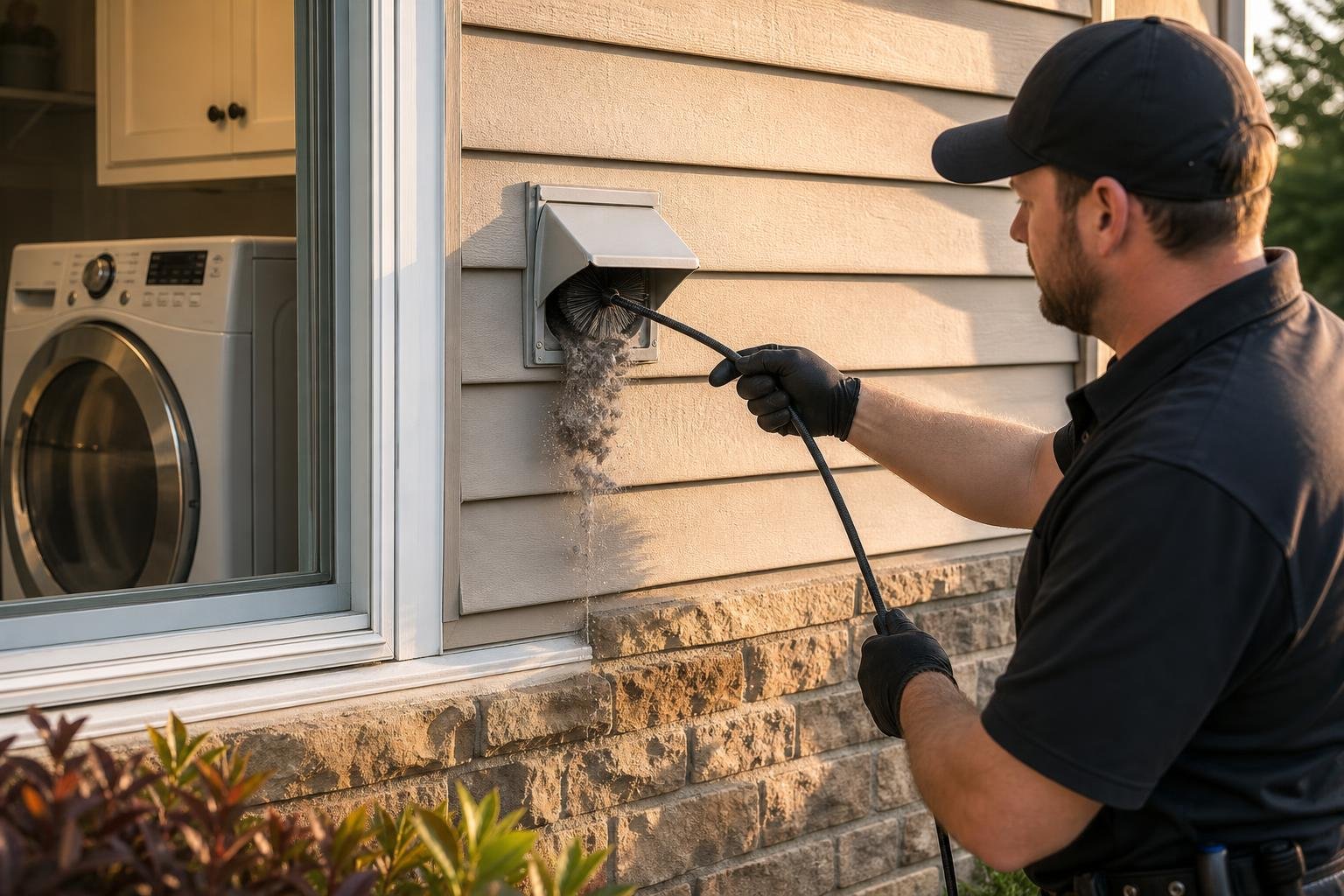
A full clean means brushing the entire developed length from both ends with a rotating brush on a flexible rod, extracting rather than pushing the lint, verifying airflow at the hood afterwards, and reporting anything found in the duct’s construction — material, length, bend count, concealment, condition of the hood.
That last part is the one that changes outcomes. A clean duct that is 50 feet long with six bends will simply re-block; the useful deliverable is knowing that and rerouting or shortening it. If you would like this handled properly, our dryer vent cleaning in Cincinnati page sets out what the service covers, and we can pair it with an annual sweep in the same visit.
FAQs
Once a year for a typical household. Move to every six months if you dry more than about eight loads a week, vent through a long or bendy duct run, have a large household, or dry pet bedding regularly. Failure to clean is the leading contributing factor in clothes dryer fires, at 34 per cent.
Clothes taking two cycles to dry, the dryer or laundry room running unusually hot, a burning or musty smell, no visible airflow at the exterior vent hood while the dryer runs, and lint appearing around the door seal. Any one of these means the duct should be checked.
The International Residential Code sets a maximum developed length of 35 feet, reduced by 5 feet for each 90-degree elbow and 2 feet 6 inches for each 45-degree elbow. A basement laundry with four 90-degree bends has only about 15 feet of straight duct left within the limit.
You can clean the lint trap housing and the first few feet with a brush kit, and you should. A full duct clean is different, because the risk is what you cannot reach - a crushed section, a disconnected joint behind drywall, a bird nest at the hood, or a screw protruding into the duct and catching lint.
The fire statistics are the main argument: an estimated 2,900 residential clothes dryer fires a year in the US, with 5 deaths, 100 injuries and $35 million in property loss. The secondary argument is running cost, because a restricted duct makes the dryer work longer for the same load.
Yes. Rigid smooth-wall metal duct accumulates lint more slowly than flexible foil or plastic, which is exactly why it is the recommended material, but it still accumulates. Annual checking remains the right interval.
Sources
- US Fire Administration — Clothes Dryer Fires in Residential Buildings (fire counts, causes and origin)
- International Code Council — International Residential Code, Chapter 15, Exhaust Systems (section M1502 duct length, diameter and installation)
- Chimney Safety Institute of America — homeowner resources