
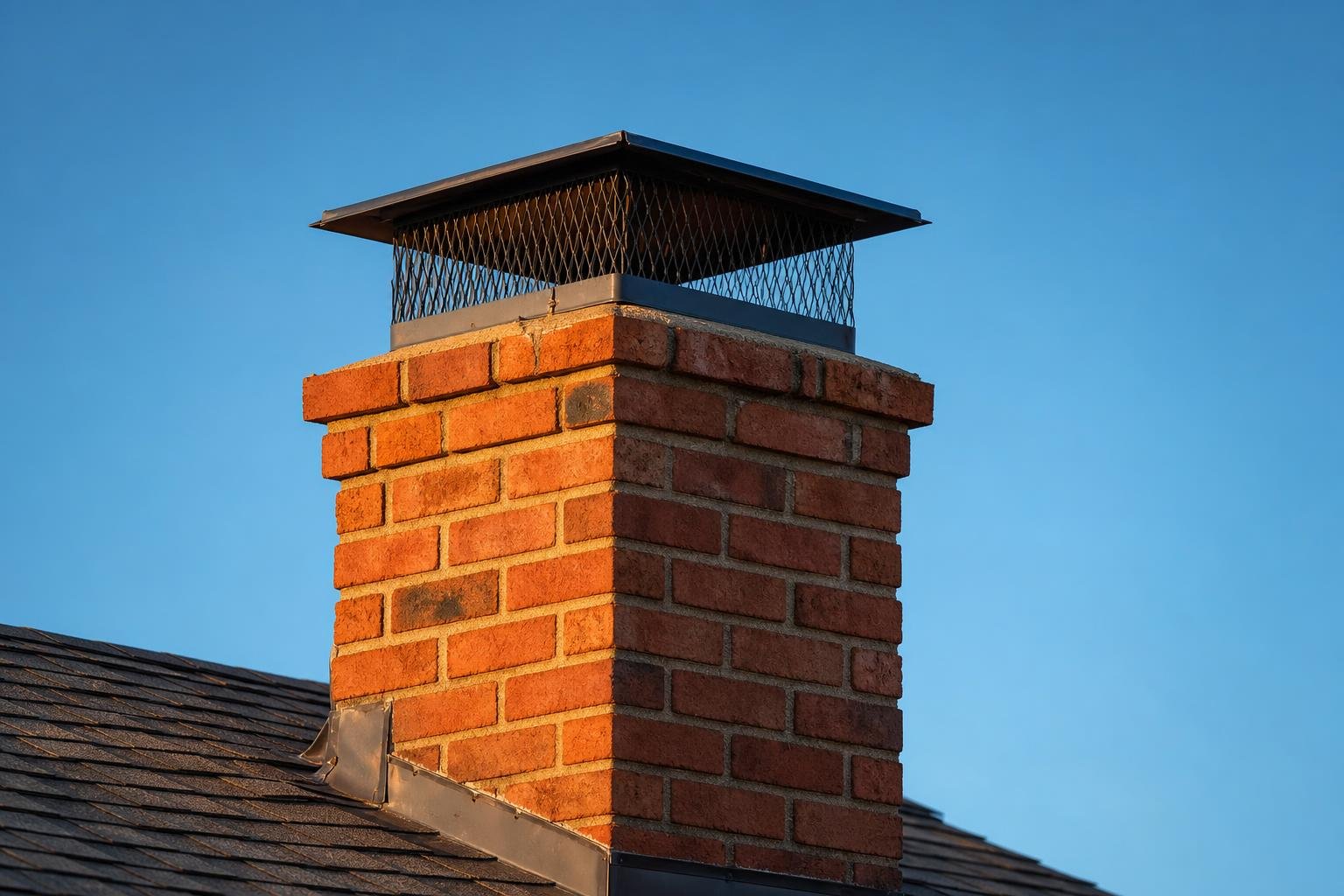
Quick AnswerChimney cap replacement runs $190 to $650 installed. Angi puts the 2026 national average at $300 and Fixr at $425. The cap alone is $50 to $500 depending on material; a chimney chase cover is $300 to $700 installed. Typical US ranges, not a quote.
How Much Does Chimney Cap Replacement Cost?
Chimney cap replacement typically costs $190 to $650 installed. Angi puts the 2026 national average at $300 and Fixr at $425, with a full span running from about $75 for a small stock single-flue cap to $1,250 for custom multi-flue fabrication. These are typical US ranges, not a quote.
That $125 gap between two national averages is worth pausing on. On dryer vent cleaning the published averages agree within about $20, because the job is one defined task. Here they do not agree, and the reason is that “chimney cap” is not one product. It covers a stock single-flue hood, a custom multi-flue cap, an outside-mount cap, a chimney chase cover and a top-sealing damper cap — five different things at five different prices.
Labour is the other half of the answer. Angi reports that labour is roughly 50 percent of the total and runs $75 to $125 per hour or $100 to $400 flat per cap installed; Fixr reports $130 to $300 for installation and $200 to $350 for a replacement. Nearly all of that is roof access. The steel is cheap; getting a person safely onto the chimney top is not.
| Source | Stated average | Typical range, installed | Full span reported | Data date |
|---|---|---|---|---|
| Angi | $300 | $190–$650 | $75–$1,000 | April 2026 |
| HomeGuide | Not stated | $200–$850 | $50–$500 unit only | February 2026 |
| Fixr | $425 | $300–$600 | $250–$1,250 | August 2025 |
| Bob Vila | $300 | $300–$600 | $75–$1,000 | October 2023 |
Angi and Bob Vila agree on $300 and on the $75 to $1,000 span. Fixr sits higher because its figures are built around prefabricated and custom caps with labour already included, and HomeGuide declines to publish a single average at all — which, given the spread, is arguably the most honest position of the four.
How Much Does a Chimney Cap Cost on Its Own?
The cap alone costs $50 to $500. HomeGuide puts the unit-only range at $50 to $500, Angi puts DIY materials at $80 to $300, and copper runs $200 to $800 for the unit. Installation is a separate $100 to $400. Typical US ranges, not a quote.
Splitting the unit price from the labour is the single most useful thing you can do with a cap quote, because the two move independently. A bigger or fancier cap adds tens of dollars; a steeper roof or a chimney that stands five feet above the ridge adds hundreds. Two homes with identical caps can be quoted $250 apart on access alone.
When you compare quotes, check what sits around the cap price. Bob Vila prices removal of the old cap at $25 to $75, and Angi groups removal, cleanup and an inspection together at $50 to $200. None of those are unreasonable charges; they are just the ones that make two apparently similar quotes land in different places.
How Much Does Chimney Cap Installation Cost?
Chimney cap installation labour runs $100 to $400. Angi reports $75 to $125 per hour or $100 to $400 flat per cap installed, Fixr reports $130 to $300 for installation and $200 to $350 for a replacement, and Bob Vila reports $100 to $200. Fixr puts the job at one to two hours.
What moves that figure is almost entirely how hard the chimney top is to stand at: roof pitch, height above grade, how far the chimney projects above the roofline, and whether the installer can work from a ladder or has to set anchors and a harness. A single-storey ranch with a low-pitch roof is the cheap end of every one of those variables.
Flue count comes next. A second flue is a second cap or, more often, a custom multi-flue cap fabricated to the crown's measurements. Permits are rarely needed for a straight cap swap, but Angi notes $25 to $100 where a jurisdiction does require one — most likely when the cap is part of a crown or chimney-top rebuild.
What Does a Chimney Cap Cost by Material?
Material sets the floor on price. Unit-only, HomeGuide reports galvanized steel at $25 to $300, aluminium at $40 to $250, stainless steel at $50 to $500 and copper at $200 to $800. Installed, Fixr puts galvanized at $325 to $375 and copper at $575 to $650.
Notice how much the ranges compress once labour is included. The installed spread between the cheapest and the most expensive metal is around $250; the unit-only spread is closer to $775. That is the clearest argument against buying the cheapest cap available: the metal is the small, one-time part of a bill you will pay again when it rusts through.
The building code offers a useful yardstick for what “durable enough” means. IRC section R1003.9.2 treats 19-gauge galvanized steel and 24-gauge stainless steel as equivalent in heat and corrosion resistance for a spark arrestor screen. In other words, stainless does the same job in noticeably thinner metal, which is why it holds its mesh for longer.
| Material | HomeGuide, unit only | Fixr, installed (prefab) | Bob Vila, installed |
|---|---|---|---|
| Galvanized steel | $25–$300 | $325–$375 | $325–$485 |
| Aluminium | $40–$250 | $400–$485 | $400–$625 |
| Stainless steel | $50–$500 | $475–$600 | $475–$780 |
| Copper | $200–$800 | $575–$650 | $575–$845 |
| Concrete | Not listed | $300–$400 | $300–$520 |
What Are the Different Types of Chimney Cap?
Five types cover almost every chimney: a single-flue cap over one flue tile, a multi-flue cap spanning several, an outside-mount cap banded around the tile, a chimney chase cover over the whole top of a framed chase, and a top-sealing damper cap that seals the flue shut when it is closed.
Which one you need is decided by the chimney top, not by preference. One clay tile of a standard size takes a stock single-flue cap. Two or more tiles, or one oversize tile, take a multi-flue cap fabricated to the crown. A damaged or very short tile that a top-mount cap cannot grip takes an outside-mount cap, which bands around the tile instead of sitting on it. A factory-built fireplace venting through a framed chase takes a chimney chase cover.
Prefabricated versus custom is the real cost fork. HomeGuide puts prefabricated caps at $200 to $650 installed against $425 to $850 for custom, and Fixr at $300 to $650 against $390 to $910. Custom is not an upgrade you choose; it is what a non-standard chimney top requires.
| Type | What it covers | Typical installed cost | Fits a chimney with |
|---|---|---|---|
| Single-flue cap | One flue tile | $200–$650 (HomeGuide, prefab) | One masonry flue, standard tile size |
| Multi-flue cap | All flues plus the crown | $390–$910 (Fixr, custom) | Two or more flues, or an oversize tile |
| Outside-mount cap | One tile, banded from outside | $200–$650 (HomeGuide, prefab) | A short or damaged tile a top-mount cannot grip |
| Chimney chase cover | The whole top of a framed chase | $300–$700 (Fixr, HomeGuide, Bob Vila) | A factory-built fireplace in a framed chase |
| Top-sealing damper cap | The flue, plus a seal at the top | $274–$521 hardware alone (Woodland Direct, Oct 2026) | A failed throat damper, or heavy draft and heat loss |
What Is the Difference Between a Chimney Cap, a Rain Cap and a Flue Cap?
In everyday use they are the same object: a metal hood with mesh sides over the flue. “Rain cap” stresses the water-shedding job, “flue cap” and “chimney cap cover” stress that it sits on one flue. In the building code, though, “chimney cap” means something else entirely: the masonry crown.
IRC section R1003.9.1 reads: “Masonry chimneys shall have a concrete, metal or stone cap, a drip edge and a caulked bond break around any flue liners in accordance with ASTM C1283. The concrete, metal or stone cap shall be sloped to shed water.” That is the sloped slab across the top of the brickwork, not the hardware above it — and rebuilding one costs $1,000 to $3,000 according to both Fixr and Bob Vila.
So when someone tells you your cap is cracked, establish which cap. Concrete cracks; sheet metal rusts and crushes. A cracked crown and a rusted-through hood are different jobs with an order of magnitude between them, and the words are used interchangeably by people who should know better.
How Much Does a Chimney Chase Cover Cost?
A chimney chase cover costs $300 to $700 installed. Fixr, HomeGuide and Bob Vila all publish exactly that range, which almost never happens. A chimney chase cover is the sheet-metal lid over the entire top of a framed chase on a factory-built fireplace, not the small hood that sits over a clay flue tile.
They fail in a characteristic way. Builders' chimney chase covers are often thin galvanized steel, flat or nearly flat, so water stands on them instead of running off. The metal rusts from the top down, and the first thing most homeowners notice is rust streaking down the siding or stucco below the chase — months or years before water reaches the firebox.
A replacement is normally fabricated in stainless or copper with a cross-break or crown in the middle so water drains, and with a collar that the flue pipe passes through. Because every chase is a slightly different size, this is measured-to-fit work, which is why it carries custom pricing rather than a shelf price.
Does a Stainless Steel Chimney Cap Cost More Than Galvanized?
Yes, roughly $150 more installed. Fixr puts a prefabricated galvanized cap at $325 to $375 installed and stainless at $475 to $600. HomeGuide's unit-only figures are $25 to $300 for galvanized and $50 to $500 for stainless. That gap is the main decision most homeowners actually make.
What the extra buys is the mesh. A galvanized cap's zinc coating is sacrificial: it protects the steel until it is gone, and then the steel rusts. The lid usually outlives the screen, so what you get is a cap that still looks present from the ground while the mesh behind it has opened up enough for a squirrel. A rusting cap also stains the masonry directly below it.
Manufacturer warranties are the most honest signal available here. HY-C publishes a limited lifetime warranty on its Shelter Pro stainless cap, built from a 16-gauge stainless base, 18-gauge stainless expanded mesh and a 24-gauge stainless hood. We could not find a manufacturer publishing a comparable lifetime warranty on a galvanized cap.
Does a Chimney Cap Have to Meet Building Code?
Where a spark arrestor is required, yes, and the specification is exact. IRC section R1003.9.2 requires a net free area at least four times that of the flue outlet, screen openings that pass no sphere larger than 1/2 inch and block none smaller than 3/8 inch, and corrosion resistance equal to 19-gauge galvanized or 24-gauge stainless steel.
The code's own words on the first of those are “not less than four times the net free area of the outlet of the chimney flue it serves”. The fourth requirement in that section is the one installers forget: “The spark arrestor shall be located with access for cleaning and the screen or chimney cap shall be removable to allow for cleaning of the chimney flue.” A cap riveted or sealed permanently to the tile turns every future sweep into a demolition job, and it is not compliant.
The mesh figure is worth checking before you buy anything. HY-C's Shelter Pro cap lists 3/4-inch expanded mesh, which would pass a sphere larger than the 1/2 inch that section allows. That is a perfectly good rain and animal guard; it is not automatically a code-compliant spark arrestor. In wildfire-exposed jurisdictions that distinction is the entire point, and local code adoption varies — confirm with your building department.
The reason the code bothers is in the fire data. The US Fire Administration counts 34,200 residential building heating fires a year, with 165 deaths and $367 million in losses, and reports that 77 percent of them were confined fires — that is, contained within a chimney, flue or fuel burner. The chimney top is where that containment either holds or does not.
Do Chimney Caps Keep Animals Out, and Can You Cap a Chimney With Birds in It?
A capped flue with intact mesh keeps birds, squirrels and raccoons out. Capping one that already holds nesting chimney swifts is a different matter: the species is protected under the federal Migratory Bird Treaty Act, which prohibits the take of protected migratory birds without authorisation from the US Fish and Wildlife Service.
Texas Parks and Wildlife puts the practical guidance plainly: it is illegal to remove or disturb chimney swifts, their nests, eggs or young during the breeding season, and chimney work should be rescheduled by at least six weeks for a chimney with eggs and at least four weeks for one with young. Late autumn, once the birds have migrated, is the agency's preferred window. Young swifts leave roughly 30 days after hatching, and the last two weeks are the noisy ones.
There is a conservation reason to get the timing right as well as a legal one. Partners in Flight lists the chimney swift as a “Common Bird in Steep Decline”, with a 67 percent population loss since 1970; it is a USFWS Bird of Conservation Concern and was classed Vulnerable by the IUCN in 2019. Masonry chimneys are now a meaningful share of what nesting habitat remains. Capping in the autumn keeps animals out permanently without taking a nest with it.
Chimney swifts are birds, not pests, and no reputable sweep will treat them as the same problem. If you are hearing scratching rather than the chittering of swifts, you are more likely dealing with a squirrel or a raccoon, and that is a job for a wildlife removal service before the cap goes on.
When Should a Chimney Cap Be Replaced?
Replace a cap when the mesh is torn or missing, when the lid is crushed or has blown off, when rust has gone through the metal, or when rust streaks appear on the masonry below it. Angi's rule of thumb is to replace rather than repair once a repair would exceed half the price of a new cap.
Most of those are visible from the ground with a zoomed-in phone photo or from a second-storey window, which is the cheapest diagnostic available to you. What you are looking for is a hood that still sits square on the tile, mesh with no gaps, and no orange staining on the brick under the cap. Animals getting in is the symptom that usually arrives before anyone looks.
In practice the cap is assessed as part of an annual inspection rather than on a visit of its own. NFPA 211 section 15.3 defines a Level I inspection as covering the readily accessible portions of the chimney, which includes the chimney top. If you are already booking that, the cap costs nothing extra to evaluate. Our chimney inspection cost guide covers what each level includes, and the warning signs guide covers what else to look for at the same time.
| Condition | Repairable | Published cost | Source |
|---|---|---|---|
| Loose cap or missing fasteners | Usually yes | $50–$150 | Angi |
| Bent leg or failed base seal | Often yes | $100–$250 | Fixr, Bob Vila |
| Torn or corroded mesh | Rarely | $190–$650 replacement | Angi |
| Crushed or deformed hood | No | $200–$850 installed | HomeGuide |
| Rust through the lid or cap missing | No | $200–$850 installed | HomeGuide |
How Much Does Chimney Cap Repair Cost?
Chimney cap repair costs $50 to $250. Angi reports $50 to $150 for work such as refastening a loose cap, and Fixr and Bob Vila both report $100 to $250. Repair is worth doing while the mesh and the lid are sound; past that point a new cap at $190 to $650 is the better buy.
What is genuinely repairable is the hardware around the cap rather than the cap itself: fasteners, a bent mounting leg, the sealant at a top-mount cap's base, a seam or collar on a chimney chase cover. What is not worth repairing is corroded mesh or a rusted-through lid, because the metal around the repair is the same age as the metal you are patching.
One thing to watch for: a repair quoted on a cap that is simply the wrong size for the tile. A cap that does not grip properly will work loose again in the next windstorm no matter how well it is refastened. Measure the outside dimensions of the flue tile before anyone buys anything, and compare them against the cap that is currently up there.
How Long Does a Chimney Cap Last?
No standards body and no cost publisher we could find puts a service life on a chimney cap, and we are not going to invent one. What is published is the warranty: HY-C backs its Shelter Pro stainless cap with a limited lifetime warranty. Galvanized caps are the ones that need watching year to year.
The physics is straightforward enough to reason about without a figure. A cap lives in flue gas that is acidic when it condenses, under rain and snow, through every freeze-thaw cycle your climate delivers, and in the case of a flat chimney chase cover with standing water sitting on it. Thinner metal with a sacrificial coating goes first, and it goes at the mesh.
The useful answer, then, is not a number of years but an interval of attention. NFPA 211 already calls for an annual inspection, and the chimney top is within a Level I scope, so the cap gets looked at every year whether or not anyone asks about it. Replace it when the inspection says so rather than on a calendar.
Can You Install a Chimney Cap Yourself?
You can, and Angi puts DIY materials at $80 to $300 against $190 to $650 for a professional replacement. The saving is real on a single-flue bolt-on cap. So is the risk, because essentially all of this job is ladder and roof work at the highest point of the house.
Three things decide whether a DIY cap is worth having. Measure the flue tile's outside dimensions, not the inside, and not the chimney. Check the mesh specification against what your jurisdiction requires if a spark arrestor is in play. And do not seal it permanently — the code requires that the cap or screen be removable so the flue can be cleaned.
Multi-flue caps and chimney chase covers are not DIY projects at any skill level, because both are fabricated to measurements taken on the roof. That is also why they carry custom pricing of $425 to $910 rather than a shelf price.
| Cost item | Do it yourself | Professional installation |
|---|---|---|
| Cap or materials | $80–$300 (Angi) | Included in the quote |
| Labour | Your time, 1–2 hours | $100–$400 (Angi), $130–$350 (Fixr) |
| Removing the old cap | Yours to do | $25–$75 (Bob Vila) |
| Total, one standard flue | $80–$300 | $190–$650 (Angi) |
| Multi-flue or chimney chase cover | Not a DIY job | $390–$910 custom (Fixr) |
What Else Changes the Price of a Chimney Cap Job?
Size, flue count and access. Angi's size table runs from $50 to $250 for a 6 by 6 inch cap up to $300 to $500 for a 17 by 29; HomeGuide's installed figures run $250 to $300 for an 8 by 8 and $625 to $700 for a 14 by 37. Permits, where required, add $25 to $100.
Added features are the line item that can quietly double a quote. Angi puts upgrades at $30 to $200, while HomeGuide's features range runs $40 to more than $2,000 — because HomeGuide counts things like a top-sealing damper or an exhaust fan as features of the cap. If a quote carries a features charge, ask what the feature is.
The cheapest time to buy a cap is during a visit you are already paying for. The access cost that makes up half the bill is already covered when a technician is on the roof for a sweep or an annual inspection, which is the practical argument for dealing with the cap then rather than as its own call-out.
Chimney Cap Replacement From Your Local Team
If you are in or around Nashville, Cincinnati, Cleveland or Minneapolis, our technicians measure the flue tile or chase on site, tell you which type of cap actually fits, and quote a flat fee in writing before any work starts — including what the price becomes if the crown underneath turns out to be the real problem. Choose your city below for local details and booking.
Nashville, TN · Cincinnati, OH · Cleveland, OH · Minneapolis, MN
FAQs
Chimney cap replacement typically costs $190 to $650 installed. Angi puts the 2026 national average at $300 and Fixr at $425, with a full span running from about $75 for a small stock single-flue cap to $1,250 for custom multi-flue fabrication. These are typical US ranges, not a quote.
The cap alone costs $50 to $500 according to HomeGuide, and Angi puts DIY materials at $80 to $300. Copper is the outlier at $200 to $800 for the unit. Installation is charged separately at $100 to $400, so on most jobs the labour is close to half the bill.
Installation labour runs $100 to $400. Angi reports $75 to $125 per hour or $100 to $400 flat per cap installed, Fixr reports $130 to $300 for a straight installation and $200 to $350 when an old cap has to come off first, and Bob Vila reports $100 to $200. Most jobs take one to two hours.
A chimney chase cover costs $300 to $700 installed. Fixr, HomeGuide and Bob Vila all publish the same range. A chimney chase cover is the sheet-metal lid over the whole top of a framed chase on a factory-built fireplace, not the small hood that sits over a single clay flue tile.
It costs roughly $150 more installed. Fixr puts a prefabricated galvanized cap at $325 to $375 installed against $475 to $600 for stainless. The extra buys mesh and a lid that do not corrode through, and at least one manufacturer backs its stainless caps with a limited lifetime warranty.
Chimney cap repair costs $50 to $250. Angi reports $50 to $150 for work such as refastening a loose cap, and Fixr and Bob Vila both report $100 to $250. Angi's rule of thumb is to replace rather than repair once the repair would cost more than half the price of a new cap.
Chimney swifts are protected under the federal Migratory Bird Treaty Act, and Texas Parks and Wildlife states that it is illegal to remove or disturb the birds, their nests, eggs or young during the breeding season. That agency advises postponing chimney work by at least six weeks where there are eggs and four weeks where there are young.
Where a spark arrestor is required, the specification is exact. IRC section R1003.9.2 calls for a net free area at least four times the flue outlet's, screen openings that pass no sphere larger than 1/2 inch and block none smaller than 3/8 inch, corrosion resistance equal to 19-gauge galvanized or 24-gauge stainless steel, and a cap or screen that is removable for cleaning.
Sources and Standards Cited
Every dollar figure on this page is a published national range from the cost sources below, with the publisher and its data date named inline. They are typical US ranges, not our quotes. Code text is quoted from a municipal reproduction of the International Residential Code; the bird protection guidance is from a state wildlife agency and the US Fish and Wildlife Service.
- International Residential Code, Chapter 10, as adopted and published by the City of Seattle — section R1003.9.1 on masonry chimney caps, drip edge and ASTM C1283 bond break; section R1003.9.2 on spark arrestors, including the four-times net free area requirement, the 1/2 inch and 3/8 inch sphere limits, 19-gauge galvanized or 24-gauge stainless corrosion equivalence, and the requirement that the cap or screen be removable for cleaning.
- NFPA 211, Standard for Chimneys, Fireplaces, Vents, and Solid Fuel-Burning Appliances — section 15.3, Level I inspection scope covering the readily accessible portions of the chimney, which is where the cap is assessed.
- US Fire Administration, Heating Fires in Residential Buildings (2017–2019) — 34,200 fires a year, 165 deaths, 600 injuries, $367 million in losses; 77 percent were confined fires, contained within a chimney, flue or fuel burner.
- US Fish and Wildlife Service, Migratory Bird Treaty Act of 1918 — prohibits the take of protected migratory bird species without prior authorisation.
- Texas Parks and Wildlife Department, Chimney Swifts: information for homeowners and chimney sweeps — it is illegal to remove or disturb the birds, nests, eggs or young during breeding season; reschedule chimney work by at least six weeks where there are eggs and four weeks where there are young; young leave about 30 days after hatching.
- Partners in Flight, Chimney Swift species assessment — 67 percent population loss since 1970, listed as a Common Bird in Steep Decline, a USFWS Bird of Conservation Concern, and IUCN Vulnerable (2019).
- Chimney Safety Institute of America, homeowner resources — the trade body whose certification to ask for when hiring.
- Angi, How Much Does a Chimney Cap Replacement Cost, updated April 2026 — national average $300, typical $190 to $650, span $75 to $1,000; labour $75 to $125 per hour or $100 to $400 flat; labour about 50 percent of total; repair $50 to $150; permits $25 to $100; features $30 to $200; removal, cleanup and inspection $50 to $200; DIY materials $80 to $300; cost by cap size.
- HomeGuide, Chimney Cap Cost, updated February 2026 — unit only $50 to $500, installed $200 to $850, labour $125 to $275; prefabricated $200 to $650 and custom $425 to $850; chimney chase cover $300 to $700; cost by material and by size; features $40 to more than $2,000.
- Fixr, Chimney Cap Replacement Cost, August 2025 — average $425, typical $300 to $600, span $250 to $1,250; prefabricated $300 to $650 and custom $390 to $910; chimney chase cover $300 to $700; chimney crown $1,000 to $3,000; cost by material; labour $130 to $300 for installation and $200 to $350 for replacement; one to two hours; repair $100 to $250.
- Bob Vila, How Much Does a Chimney Cap Cost to Install, updated October 2023 — national average $300, range $75 to $1,000; cost by material and by cap shape; labour $100 to $200; repair $100 to $250; old cap removal $25 to $75; chimney chase cover $300 to $700; chimney crown $1,000 to $3,000.
- HY-C, Shelter Pro stainless steel chimney cap product specification — 16-gauge stainless base, 18-gauge 3/4 inch stainless expanded mesh, 24-gauge stainless hood, limited lifetime warranty. Checked October 2026.
- Woodland Direct, top-sealing chimney dampers category — published retail hardware prices of $273.55 to $521.23, checked October 2026. Retail prices for the hardware only, excluding installation.