
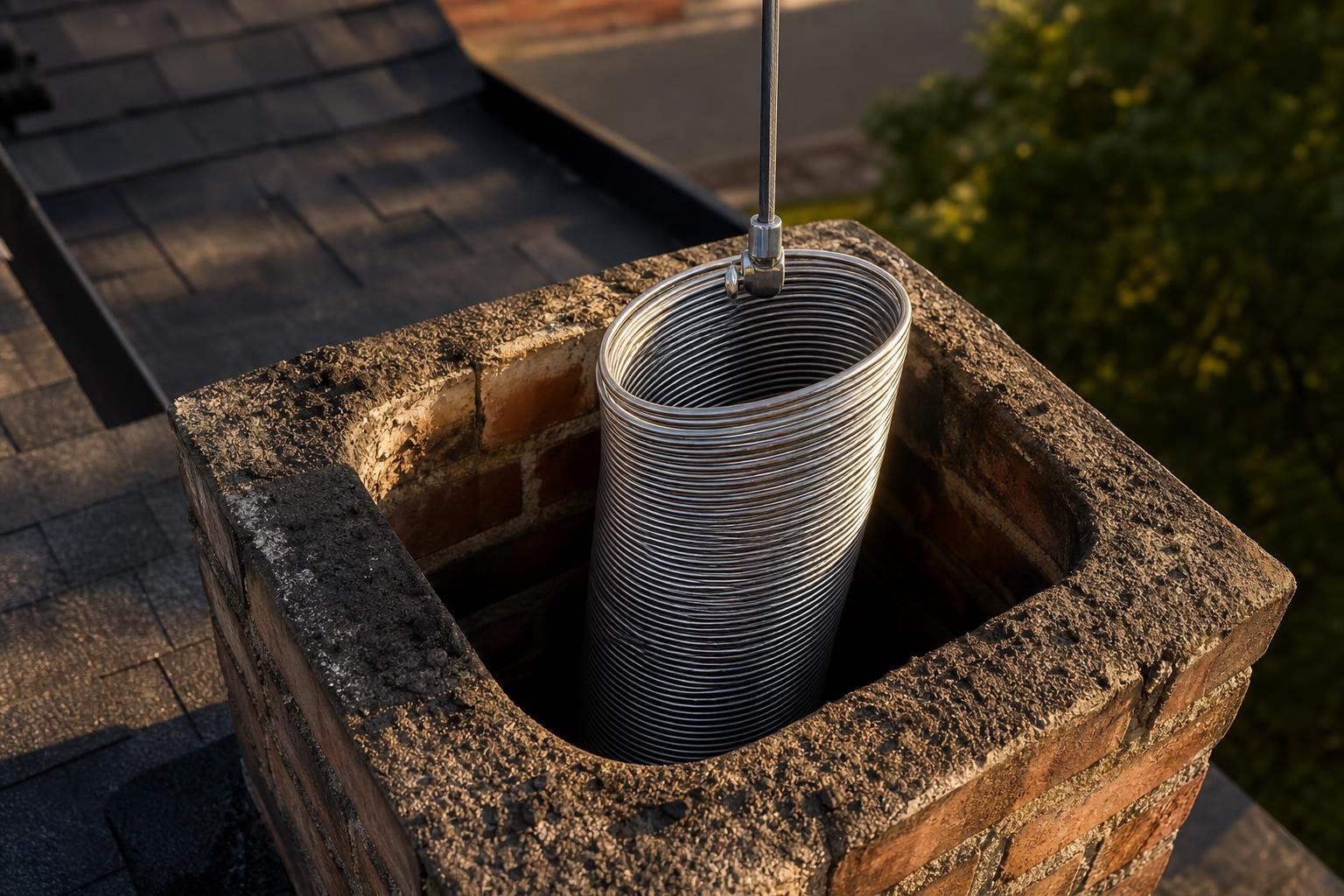
Quick AnswerA chimney liner costs $1,500 to $4,000 installed and relining costs $1,200 to $4,600, per HomeGuide. Fixr puts the national average at $2,500. Aluminium is the cheapest at $625 to $2,250 installed; cast-in-place is the dearest at $2,000 to $7,000. Typical US ranges, not quotes.
How Much Does a Chimney Liner Cost?
A chimney liner costs $1,500 to $4,000 installed. HomeGuide publishes that range and a full span of $900 to $7,000; Fixr publishes $1,800 to $4,000 with a national average of $2,500. These are typical US ranges, not a quote.
Three numbers do most of the work in a liner quote: the material, the height of the flue, and whether anything has to come out before the new liner goes in. A 20-foot single-storey flue taking a flexible stainless liner sits near the bottom of the range. A 35-foot flue in a three-storey house, with failed clay tile that has to be broken out tile by tile, sits near the top of it.
What is not a major driver is the liner itself. At $20 to $90 per linear foot for stainless, the metal on a 25-foot flue is $500 to $2,250 — often less than half the bill. The rest is labour, roof access, and removal of whatever is already in the chimney.
| Source | Typical range, installed (USD) | Stated average (USD) | Data date |
|---|---|---|---|
| HomeGuide | $1,500–$4,000 | Not stated | February 2026 |
| Fixr | $1,800–$4,000 | $2,500 | January 2025 |
| eLocal, citing Bob Vila | $625–$7,000 | $2,500 | Undated |
The two publishers that state an average agree on $2,500, which is unusual in this trade — on chimney caps the published averages sit $125 apart. The disagreement here is about the span, not the middle: eLocal’s $625 floor is an aluminium liner for a gas appliance and its $7,000 ceiling is a cast-in-place pour, so its range is really two different jobs reported as one.
What Does a Chimney Liner Cost by Material?
Material sets the floor and the ceiling. Installed, HomeGuide reports aluminium at $625 to $2,250, stainless steel at $900 to $3,800, clay or terracotta tile at $2,000 to $3,500 and cast-in-place at $2,000 to $7,000. Typical US ranges, not quotes.
| Liner material | Material cost per linear foot (USD) | Installed total (USD) | What it suits |
|---|---|---|---|
| Aluminium | $5–$30 | $625–$2,250 | Gas appliances only; not rated for wood or oil |
| Stainless steel | $20–$90 | $900–$3,800 | Wood, gas and oil; 316Ti alloy for all fuels |
| Clay or terracotta tile | $6–$15 | $2,000–$3,500 | Masonry flues; the old tile must come out first |
| Cast-in-place | $40–$120 | $2,000–$7,000 | Masonry flues whose mortar joints have failed |
Clay tile is the cheapest material per foot and one of the dearest jobs installed. That is not a contradiction: relining with tile means removing the existing tile one piece at a time through the flue, which is slow, manual work. The material is $6 to $15 a foot and the labour is most of the $2,000 to $3,500.
Stainless steel also splits by form. Fixr prices rigid stainless at $20 to $40 per linear foot and flexible stainless at $40 to $90, and puts most homeowners at around $2,500 for a flexible double-wall stainless liner. Rigid is cheaper per foot but only fits a straight flue; a chimney with an offset needs flexible.
| Liner material | Rigid, per linear foot (USD) | Flexible, per linear foot (USD) | Fits |
|---|---|---|---|
| Aluminium | $5–$20 | $15–$30 | Straight or offset gas flues |
| Stainless steel | $20–$40 | $40–$90 | Straight flue rigid; offset flue flexible |
| Cast-in-place | $25–$250 | Not applicable | Poured in place; any flue shape |
| Clay or terracotta | $6–$15 | Not applicable | Straight masonry flues only |
Why Do Published Liner Prices Disagree So Much?
Because the published figures are not all measuring the same unit, and at least one of them is labelled wrongly. eLocal reports stainless steel at “roughly $100 per square foot (including labor)”, single-wall metal at “$20 and $40 per square foot” and cast-in-place at “about $250 per square foot”. Those are the per-linear-foot figures every other publisher reports, with the wrong unit attached.
It matters, because a liner is priced by the running foot of flue, not by area. If you read $40 per square foot as a real figure and multiply it by the surface area of a 25-foot flue, you arrive at a number several times the actual job. When you compare two quotes, check that both are quoting per linear foot of flue and that both state the flue height they measured.
HomeGuide has its own internal conflict worth knowing about: it gives aluminium an installed figure of $10 to $30 per linear foot in one place and an installed total of $625 to $2,250 in another, and does not reconcile them. We have used the installed totals throughout this guide, because that is the number on a quote.
Which Chimney Liner Should You Choose?
Choose flexible 316Ti stainless when the masonry flue is structurally sound, has an offset, and serves wood or any mixed fuel. It is the default for a reason: it fits a chimney that is not perfectly straight, it is rated for every common fuel, and at $900 to $3,800 installed it sits in the middle of the price range rather than at the top.
Choose rigid stainless only if the flue runs dead straight from the appliance to the crown. At $20 to $40 per linear foot it is roughly half the material cost of flexible, which on a tall flue is a real saving — but it cannot be persuaded round an offset, and a rigid liner forced into a bent flue is worse than no replacement.
Choose aluminium if, and only if, the appliance is gas and will stay gas. At $625 to $2,250 installed it is the cheapest compliant option for a gas flue. It is not rated for wood or oil, so if there is any chance of converting back to a wood-burning fireplace later, the cheaper liner becomes the more expensive decision.
Choose cast-in-place when the mortar joints have failed or the clay tile is spalling. This is the case where a steel liner does not solve the problem: dropping a stainless liner inside a crumbling flue restores the venting path but not the chimney’s structure. Cast-in-place rebuilds the flue wall itself, which is why it costs $2,000 to $7,000.
And a case for spending nothing: if a sweep recommends relining without having run a camera up the flue, get a second opinion before agreeing. A liner is the single most expensive thing most chimneys ever need, and the evidence for needing one is visual.
When Does a Chimney Need Relining?
A chimney needs relining when the existing liner is cracked, missing, wrongly sized for the appliance, or no longer continuous. NFPA 211 requires a chimney to have a continuous liner, and a Level 1 inspection checks the flue specifically for liner continuity, damage, deposits and blockage.
In practice relining is triggered by one of four findings. A camera scan shows cracked or missing tile. The flue is oversized for a new appliance, so the flue gases cool and condense instead of drawing. A chimney fire has heat-cracked the tile. Or an appliance of a dissimilar type, rating or efficiency is being connected to a flue that was never sized for it.
All four of those are Level 2 findings, not Level 1 ones, because they need a camera. NFPA 211 requires a Level 2 inspection before relining, on the sale or transfer of a property, when an appliance of dissimilar type or rating is added or replaced, and after a chimney or building fire or a weather or seismic event. A Level 2 costs $250 to $600 for a single flue — see our chimney inspection cost guide — which is the cheapest way to find out whether a $2,500 liner is actually needed.
How Much Does Relining Cost Compared With a New Liner?
Relining an existing chimney costs $1,200 to $4,600 on average, per HomeGuide, against $1,500 to $4,000 for a liner installation. The two ranges overlap almost entirely, because on most jobs they describe the same work: a chimney that already has a flue is being given a new one.
The figure moves on what has to be removed. Feeding a flexible stainless liner down a clear masonry flue and insulating it is a one-day job for two people. Breaking out failed clay tile first can double the labour, which is why clay relining carries a higher installed total than its $6 to $15 per foot material cost suggests.
Insulation is the add-on most worth keeping in the quote. An insulated liner holds flue temperature up, which keeps the draught working and slows creosote condensation — and creosote is what the 1/8-inch sweeping threshold exists to control. A quote that omits insulation on an exterior chimney in a cold climate is cheaper for a reason.
Chimney Liner Cost: Questions We Get Asked
How much does a chimney liner cost to install?
A chimney liner costs $1,500 to $4,000 installed according to HomeGuide, with a full published span of $900 to $7,000. Fixr publishes $1,800 to $4,000 and a national average of $2,500. Aluminium is cheapest at $625 to $2,250 installed and cast-in-place is dearest at $2,000 to $7,000.
How much does chimney relining cost?
Chimney relining costs $1,200 to $4,600 on average, per HomeGuide. The spread is driven by what has to be removed first: feeding a flexible stainless liner down a clear flue is the cheap end, and breaking out failed clay tile one piece at a time is the dear end.
How much is a chimney liner per foot?
Liner material costs $5 to $30 per linear foot for aluminium, $20 to $90 for stainless steel, $6 to $15 for clay or terracotta tile and $40 to $120 for cast-in-place, per HomeGuide. Liners are priced per linear foot of flue, not per square foot.
How long does a chimney liner last?
Service life depends on material and alloy rather than price. Stainless steel liners are commonly sold with long or lifetime warranties, and 316Ti is the alloy rated for all fuels including gas and oil. Aluminium is rated for gas only and should not be used where wood or oil may be burned.
Do I need a chimney liner?
NFPA 211 requires a chimney to have a continuous liner sized to the appliance it serves. Whether yours needs replacing is a camera question: a Level 2 inspection scans the flue interior and verifies the liner material and flue sizing against the appliance. That inspection costs $250 to $600 for a single flue.
Can I install a chimney liner myself?
A liner must be correctly sized to the appliance and continuous along the full flue, and both are verified at a Level 2 inspection. A liner that is the wrong diameter will not draw properly even when it is installed neatly, so the sizing calculation matters more than the physical work.
Last updated October 2026. Figures are typical published US ranges from HomeGuide, Fixr and eLocal on the dates shown, not quotes. Call your local crew for a measured price.