
Quick AnswerGas fireplace service is an annual cleaning, safety check and tune-up of the burner, pilot, safety sensors, glass, logs and vent. NFPA 211 calls for fireplaces and vents to be inspected at least once a year. Published 2026 data puts a service visit at roughly $75 to $375 depending on whether cleaning is included — a typical US range, not a quote.
What Is Gas Fireplace Service?
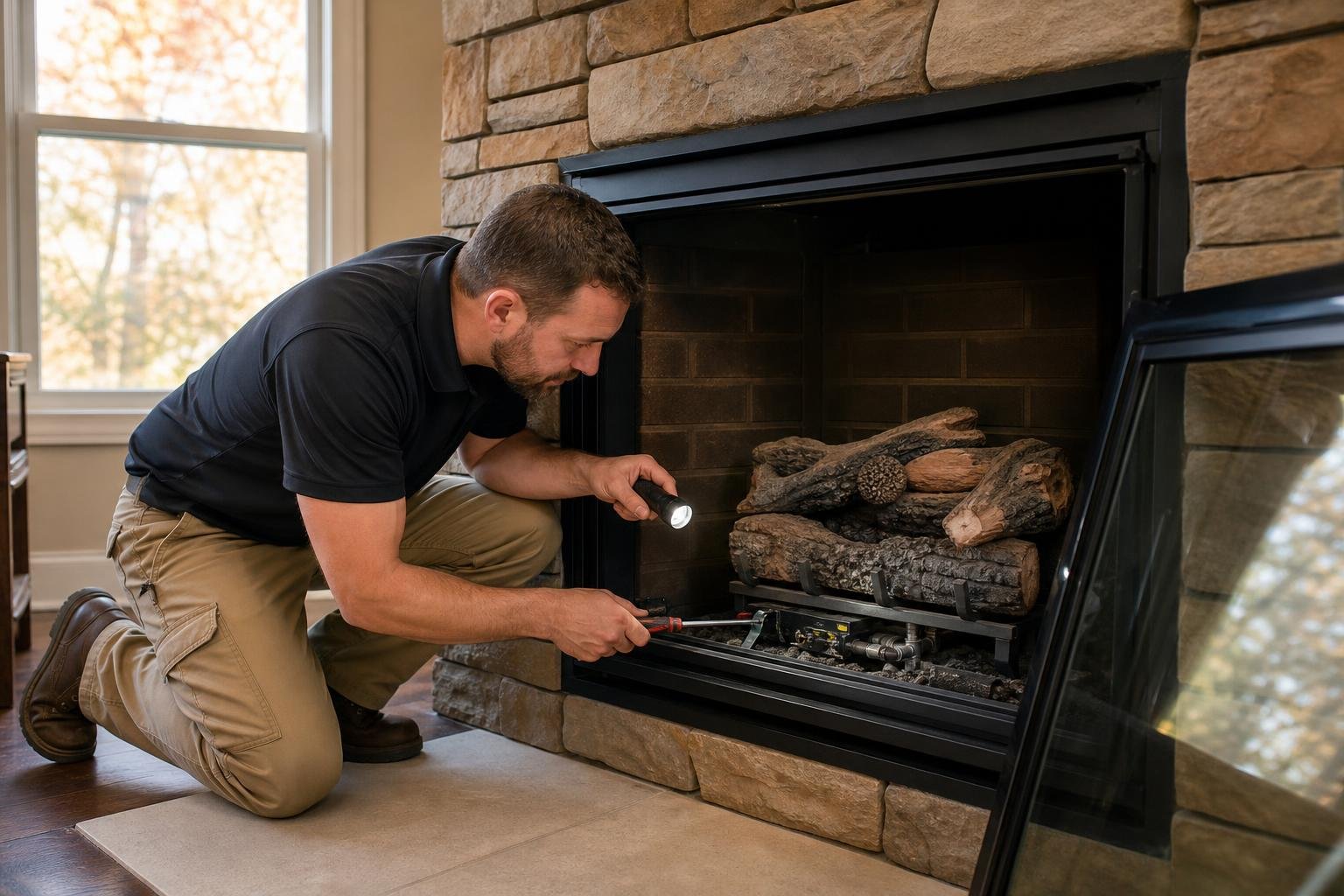
Gas fireplace service is a scheduled visit in which a technician cleans the burner and pilot, tests the safety sensors and gas connections, cleans the glass, resets the logs and inspects the vent. The goal is to catch a failing part or a blocked vent before it stops the fireplace, or sends combustion gases into the room.
It applies to every kind of gas hearth: direct-vent fireplaces, natural-vent (B-vent) fireplaces, gas inserts set into an old wood-burning fireplace, vented gas log sets and vent-free units. What changes from one type to the next is where the technician spends the time, which the comparison table further down sets out.
Gas burns cleanly, and that is exactly why owners skip service: there is no black creosote to remind you. When the Hearth, Patio & Barbecue Association introduced new glass-front safety standards, it cited roughly 11 million US households with gas fireplaces. Every one of those is a combustion appliance running inside the living space, and the vent, the gas valve and the flame sensor wear or clog whether or not anything looks wrong from the sofa.
What Does an Annual Gas Fireplace Service Include?
A complete annual service checks the parts that keep the flame safe and the exhaust moving outdoors: the pilot and burner, the thermocouple or thermopile, gas pressure and the fittings, the glass and its gasket, the log and ember layout, the vent and its outside termination, and the carbon monoxide alarm serving that room.
- Pilot and burner cleaning. Dust, pet hair and spider webs in the pilot hood and burner ports cause lazy, yellow or uneven flames, and they are behind a large share of “won’t stay lit” calls.
- Thermocouple or thermopile test. These sensors hold the gas valve open only while the pilot flame is proven. A technician measures their millivolt output instead of guessing whether they are weak.
- Gas pressure and leak check. Supply and burner pressure are compared with the rating plate, and every accessible fitting is checked for leaks.
- Glass cleaning and gasket inspection. The glass comes off, the white combustion film is removed with a cleaner made for fireplace glass, and the gasket is checked. On a sealed unit the glass is part of the venting system.
- Log and ember placement. Logs go back to the manufacturer’s layout diagram. A log sitting in the flame path causes soot and incomplete combustion.
- Vent and termination inspection. The outside cap or vertical termination is checked for nests, debris, damage and blocked clearances.
- Controls, blower and safety screen. The wall switch, remote, any blower fan and the protective mesh screen are tested or inspected.
- Carbon monoxide alarm. A working CO alarm near the fireplace room is confirmed.
If a visit only wipes the glass and never looks at the vent or the gas side, it was a cleaning, not a service.
How Often Should a Gas Fireplace Be Serviced?
Once a year, before the heating season. NFPA 211, the national standard for chimneys, fireplaces and vents, states that “chimneys, fireplaces, and vents shall be inspected at least once a year” and “cleaned and repaired if necessary.” Most gas fireplace manufacturers also call for annual service by a qualified technician in the owner’s manual.
The Chimney Safety Institute of America (CSIA) recommends annual inspection for gas appliances too, pointing out that a flue can be made non-functional by bird nests or other debris even when the fuel itself burns cleanly. Early fall is the practical window. The vent has sat idle all summer, which is when birds and insects move in, and service calendars fill quickly after the first cold snap.
Book more often than yearly if the fireplace is a main heat source, if the glass sooted up during the season, or if a part was replaced and the unit hasn’t behaved the same since. A fireplace lit only a few evenings a year still needs its annual check: a nest in the vent doesn’t care how often you use it. For how gas fits into overall chimney care, see how often you should sweep your chimney.
How Much Does Gas Fireplace Service Cost?
Published 2026 US data puts a gas fireplace inspection at about $55 to $200, and an inspection with cleaning at about $150 to $375. Thumbtack reports annual maintenance averaging around $150. These are typical US ranges, not a quote: your price depends on the unit type, access and what the technician finds.
| Service | Typical US range | Source |
|---|---|---|
| Inspection only | $55 to $130 | HomeGuide, Feb 2026 |
| Gas fireplace inspection | $100 to $200 | Angi, Jul 2026 |
| Routine maintenance / cleaning | $75 to $200 | Angi, Jul 2026 |
| Inspection and cleaning | $150 to $375 | HomeGuide, Feb 2026 |
| Annual maintenance (average) | About $150 | Thumbtack, 2026 |
| Technician labor, per hour | $100 to $150 | Thumbtack, 2026 |
Three things explain most of the spread. Unit type matters: Angi puts linear fireplaces at $100 to $250 to inspect against $75 to $200 for an insert, because wide burners and long glass panels take longer. Location matters: Angi’s city figures run from $75 to $125 in Houston up to $150 to $250 in New York City. And scope matters, since a visit that includes glass removal, burner cleaning and a vent check costs more than one that only inspects and reports. When comparing prices, ask exactly which of the checklist items above are included.
What Do Common Gas Fireplace Repairs Cost?
Most gas fireplace repairs are part replacements. Published ranges run from about $90 to $350 for an igniter, $100 to $350 for a thermocouple, and $150 to $600 for a gas or control valve, up to $250 to $1,000 for a blower motor. Burner and gas line work sit at the top end. Typical US ranges, not a quote.
| Repair | What the part does | Published US range |
|---|---|---|
| Igniter replacement | Lights the pilot or burner electronically | $90 to $350 |
| Pilot assembly repair | Holds the small standing flame that lights the burner | $100 to $350 |
| Thermocouple replacement | Proves the pilot flame; shuts the gas off if it goes out | $100 to $350 |
| Thermopile replacement | Generates the millivolts that run the valve and wall switch | $150 to $300 |
| Gas / control valve replacement | Meters gas to the pilot and burner | $150 to $600 |
| Control module repair | Electronic ignition and control board | $200 to $650 |
| Fogged glass replacement | Sealed front panel | $200 to $300 |
| Burner repair | Distributes gas across the firebox | $250 to $800 |
| Blower motor repair | Pushes heat into the room | $250 to $1,000 |
| Gas line repair | Supply piping to the unit | $150 to $1,000 |
The overlap between the two tables is the argument for annual service. A thermocouple that reads weak during a fall service is a planned swap at the same visit. The same part failing on the coldest night in January costs the same, plus the evening you spend waiting for an appointment. If your fireplace has already stopped working, our gas fireplace repair and service page covers what we diagnose and how the written estimate works.
How Does Service Differ by Gas Fireplace Type?
The checklist is the same across types, but the priorities differ. Direct-vent units depend on a sealed glass front and a clear outside termination. Natural-vent units depend on draft up a vertical pipe. Inserts depend on the liner inside the old chimney. Vent-free units depend on their oxygen depletion sensor, because the room itself is the vent.
| Fireplace type | How it vents | Where service focuses |
|---|---|---|
| Direct-vent | Sealed combustion: draws outside air and exhausts through a two-layer pipe through the wall or roof | Glass gasket seal, outside termination cap, burner and pilot |
| Natural-vent (B-vent) | Uses room air and exhausts by natural draft up a vertical B-vent pipe | Draft and spillage test, vent pipe condition, cap |
| Gas insert | Sits in an existing wood fireplace; exhausts through a liner run up the old chimney | Liner connection and condition, chimney cap, masonry above the roof |
| Vented gas logs | Burn in an open masonry fireplace; exhaust rises up the chimney | Damper held open per the log set’s instructions, flue clear, cap in place |
| Vent-free (ventless) | No vent; combustion products stay in the room | Oxygen depletion sensor, burner cleanliness, room size, CO alarm |
Vent-free units deserve extra care. Because they release their exhaust into the room, a dirty burner or a failing oxygen depletion sensor affects the air you breathe directly, and some jurisdictions restrict their use in homes. Inserts sit at the other extreme: the fireplace itself may be brand new while the masonry chimney around its liner is decades old, so that chimney still needs checking above the roofline. Our guide to whether you need a chimney cap covers the most common failure point up there.
What Can You Do Yourself Between Services?
Homeowners can safely look after the outside of the system: keep the vent termination clear of snow, leaves and plants, dust the controls and louvers, test the carbon monoxide alarm monthly, and keep the protective screen in place. Anything on the gas side — valve, fittings, pilot assembly, pressure — belongs to a qualified technician.
- Keep the termination clear. Check the outside vent cap after heavy snow and during leaf season, and don’t let shrubs grow over it.
- Test the CO alarm. Press the test button monthly and replace the unit at the end of its rated life, which is printed on the back.
- Dust, don’t disassemble. Vacuum the lower louvers and control compartment with the unit off and cool. Leave the logs and burner where they are.
- Clean glass only if the manual allows it. Many fronts are sealed panels. A poorly reseated glass door can leak combustion gases, so if you’re unsure, leave it for the service visit.
The line is drawn at gas. NFPA 54, the National Fuel Gas Code governs gas piping and appliance connections, and local rules often require a licensed or qualified installer for that work. A leak test with soapy water is not a substitute for a technician with a combustible gas detector and a manometer.
What Are the Warning Signs a Gas Fireplace Needs Service Now?
Book service before the next use if the pilot won’t stay lit, the flames turn tall, yellow or sooty, black soot appears on the glass or logs, a carbon monoxide alarm sounds, ignition is delayed and lights with a whoosh, or a smell persists after the first fires of the season.
- Pilot won’t stay lit. Usually a dirty pilot or a weak thermocouple or thermopile. The valve is doing its job by shutting off.
- Yellow, tall or lazy flames and black soot. Signs of incomplete combustion, which also means more carbon monoxide.
- Delayed ignition. Gas building up before it lights. Stop using the unit until it has been checked.
- A CO alarm activation. Turn the fireplace off, ventilate, get everyone outside and call for help.
- The switch or remote is intermittent. Often a thermopile losing output, a cheap fix when caught early.
Carbon monoxide is why this list matters. The CDC estimates that each year more than 400 Americans die from unintentional carbon monoxide poisoning not linked to fires, more than 100,000 visit an emergency department and more than 14,000 are hospitalized. Not all of that comes from fireplaces, but the early symptoms — headache, dizziness, weakness, upset stomach, vomiting, chest pain and confusion — are easily mistaken for flu. For odor-specific causes, see fireplace smell causes and fixes.
If you smell gas: don’t light anything or flip switches, leave the house, and call your gas utility or 911 from outside. Don’t go back in until you are told it is safe.
Why Does Gas Fireplace Glass Turn White or Black?
A white, hazy film is normal: it is mineral residue left by combustion, and it bakes on harder the longer it is left. Black soot is not normal. It points to incomplete combustion, usually from a misplaced log, a dirty burner, or an air-supply or venting problem, and it needs a technician rather than a stronger glass cleaner.
The white film is a cosmetic issue that an annual service handles. Use only a cleaner the manufacturer approves; general household glass cleaners can leave residue that etches when the glass heats up. Soot is a combustion problem, and it tends to come with other symptoms: soot on the logs, a sooty smell, or a flame that has changed color. If you wipe soot off and it comes back within a few fires, stop using the unit and book a service, because whatever is producing it is also producing more carbon monoxide.
Is a Glass-Front Gas Fireplace a Burn Risk?
Yes, especially for young children. Under industry safety standards, glass-front gas fireplaces whose glass can exceed 172°F must carry a protective barrier screen, and every newly manufactured unit has had one since January 1, 2015, according to the Hearth, Patio & Barbecue Association. The glass can take an hour or more to cool after the fire is off.
A fireplace installed before 2015 may have no screen at all. Many manufacturers sell a barrier made to fit their older models, so ask about one at your next service; the technician can read the model number off the rating plate. On newer units, the service visit should confirm the screen is in place and undamaged, since screens are often removed for cleaning and never put back. Treat the glass as hot whenever the fireplace has run in the last hour, and keep children and pets back from it. If there is a crawling or toddling child in the house, our guide to how to baby proof a fireplace sets out the barrier, gate and hearth steps in the order they matter.
Does a Gas Fireplace Chimney Need Sweeping?
Not in the wood-burning sense, because gas doesn’t produce creosote. But the vent or chimney still needs an annual inspection for nests, debris and deterioration, and an insert venting into an old masonry chimney needs its liner and cap checked. A chimney that once served a wood fire should be swept before a gas insert goes in.
That last point catches people converting from wood to gas. Old creosote left in a flue is still flammable, and it doesn’t disappear because the fuel changed. Gas exhaust also contains a lot of water vapor, which can condense in a cold, oversized masonry flue and attack mortar and clay tile over time — one reason gas inserts vent through a properly sized liner. If your gas fireplace shares a chimney with a wood-burning appliance, the wood side follows its own schedule; our guide to creosote buildup and chimney fire risk explains how quickly that flue can become a hazard.
Gas Fireplace Service From Your Local Team
If you live in or around Nashville, Cincinnati, Cleveland or Minneapolis, our local crews handle annual gas fireplace service, safety inspections and repairs, with a written estimate before any repair work starts. Choose your city below to see local service details and book a visit.
Nashville, TN · Cincinnati, OH · Cleveland, OH · Minneapolis, MN
FAQs
Yes. NFPA 211 calls for chimneys, fireplaces and vents to be inspected at least once a year, and most manufacturers specify annual service by a qualified technician. A yearly visit catches blocked vents, weak safety sensors and leaking fittings before they cause a no-start or a carbon monoxide problem.
Published 2026 US data puts a gas fireplace inspection at roughly $55 to $200 and an inspection with cleaning at roughly $150 to $375, with annual maintenance averaging around $150. These are typical US ranges, not a quote. Parts replaced during the visit, such as a thermocouple or igniter, are priced separately.
An inspection checks and reports on the venting, gas connections, safety controls and carbon monoxide. A service adds the hands-on work: cleaning the burner, pilot and glass, resetting the logs and correcting anything out of specification. Many companies combine both in one annual visit, which is why their price ranges overlap.
You can keep the outside vent termination clear, dust the unit, test the carbon monoxide alarm and, if the owner's manual allows it, clean the glass once it is fully cool. Work on the gas valve, fittings, pilot assembly or gas pressure belongs to a qualified technician working to NFPA 54 and your local code.
The most common causes are a dirty pilot flame that no longer heats the thermocouple properly, a worn thermocouple or thermopile, or a draft disturbing the pilot. The thermocouple closes the gas valve when it cannot sense the flame, which is a safety feature. Published ranges for thermocouple replacement run about $100 to $350.
A brief dusty or burning smell during the first fires of the season is common as dust burns off the burner. A persistent smell, a rotten-egg odor, or any smell accompanied by headaches or dizziness is not normal. If you smell gas, leave the house and call your gas utility from outside.
Sources and Standards Cited
Cost figures are published national ranges from the sources below, not our quotes. Standards are linked to their publishers.
- NFPA 211, Standard for Chimneys, Fireplaces, Vents, and Solid Fuel–Burning Appliances — annual inspection requirement.
- NFPA 54 / ANSI Z223.1, National Fuel Gas Code — gas piping and appliance installation.
- Chimney Safety Institute of America, Homeowner Resources — annual inspection of gas appliances.
- CDC, Carbon Monoxide Poisoning Basics — annual deaths, ED visits, hospitalizations and symptoms.
- Hearth, Patio & Barbecue Association, glass-front barrier standard announcement — 172°F threshold, January 1, 2015 effective date, 11 million households.
- Angi, Gas Fireplace Inspection Cost, updated July 2026.
- HomeGuide, Fireplace Repair Cost, updated February 2026.
- Thumbtack, Gas Fireplace Repair Cost, 2026.
- Fireplace Experts, Gas Fireplace Service & Repair Costs, 2026.