
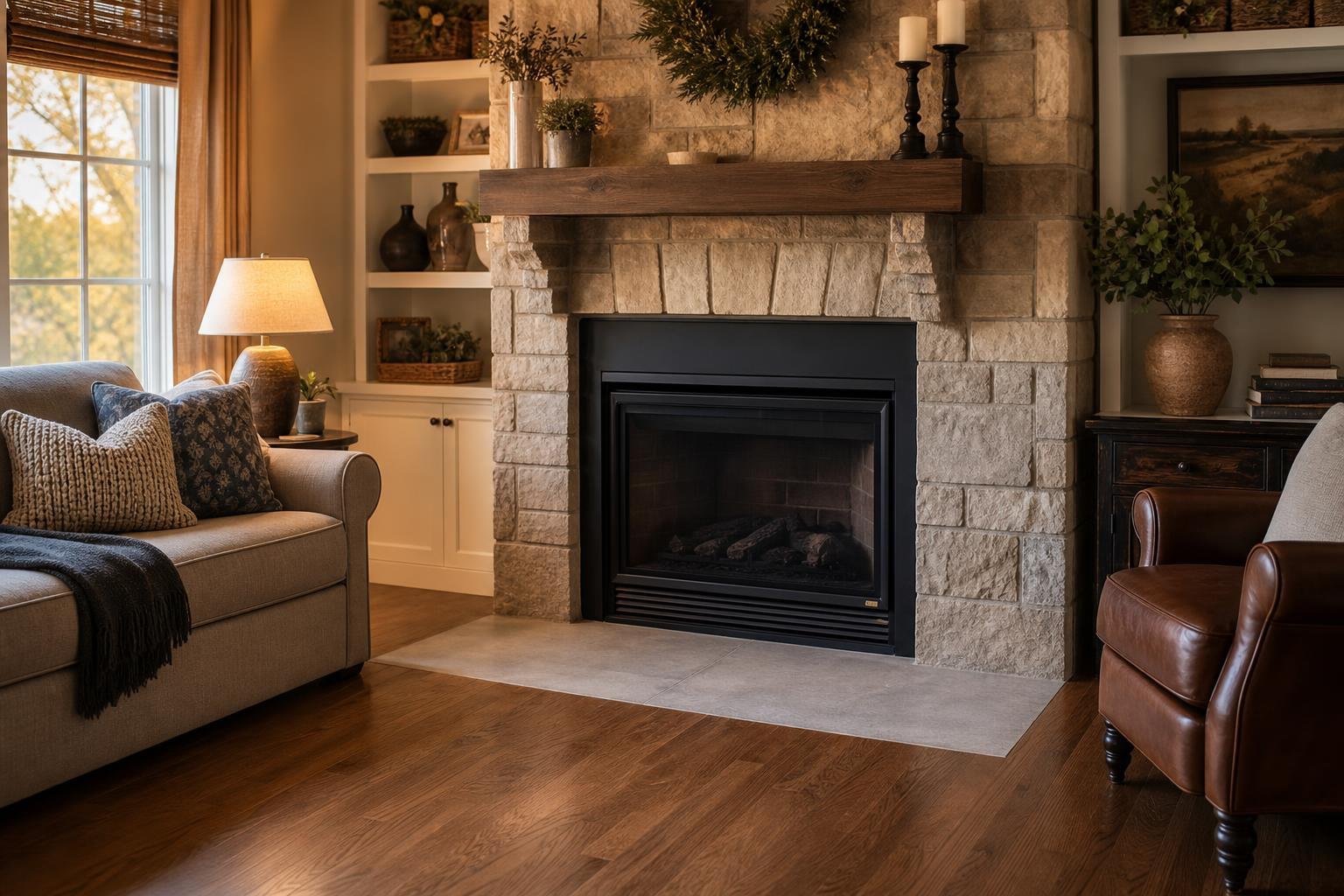
Quick AnswerBaby proof in this order: barrier the glass, pad the hearth edge, gate the whole hearth, lock the controls. Glass-front gas is the urgent one — Nationwide Children’s Hospital puts that glass above 500 to 1,000°F and still hot an hour or two after shutdown. Padding and a gate cost $45 to $160; a manufacturer barrier screen for an older unit is $400 to $840. Typical US ranges, not a quote.
How Do You Baby Proof a Fireplace?
Baby proof a fireplace in the order the hazards can hurt a child, not the order the shops stock. Barrier the hot glass first, pad the hearth edge second, gate the whole hearth third, lock the gas controls fourth, and have the flue inspected before the first fire of the season. Padding alone is the common mistake.
The nine steps below are ordered that way. Steps one to four handle contact burns, which are fast and permanent. Steps five and six handle the falls and knocks that are far more common but far less serious. Steps seven to nine are the ones a chimney sweep sees go wrong most often: the unused fireplace stuffed with a cushion, the flue nobody has looked up in a decade, and the missing carbon monoxide alarm.
- Confirm or fit a safety barrier on a glass-front gas fireplace.
- Treat the glass as hot for two hours after shutdown, not two minutes.
- Pad the hearth edge and corners.
- Set a free-standing gate far enough back that a reaching arm falls short of the glass.
- Clear the hearth of tool sets, lighters, matches and loose ash.
- Soften the floor in front of a brick or stone apron.
- Lock the ignition — wall switch, remote and key valve.
- Seal an unused fireplace properly rather than blocking it with soft furnishings.
- Book the annual inspection and fit a carbon monoxide alarm before you light anything.
Why Is Gas Fireplace Glass the Most Urgent Hazard?
Because the burn happens faster than a parent can cross the room, and the glass looks harmless. Skin burns when the base layer of the epidermis reaches 44°C, roughly 111°F, according to a 2017 review in the journal Burns. Gas fireplace glass runs several hundred degrees above that, so contact is injury, not a warning.
The scale is documented. A five-year retrospective study across 17 US burn centres, led by Dr Lucy Wibbenmeyer and published in the Journal of Burn Care and Research, collected 402 glass-front fireplace injuries and extrapolated to roughly 17,000 medical visits, 360 emergency room visits and 33 hospital admissions a year. Over 95 percent were to the palm of the hand — the signature of a crawling child pushing up against the glass — and up to 11 percent needed surgery.
The American Academy of Pediatrics, which published those figures, also notes that more than 120,000 US children are treated in emergency departments for fire or burn injuries each year, and that children under five are disproportionately represented. A palm burn is not a bruise: it is the hand a child will use for everything else for the rest of their life.
Does Your Gas Fireplace Already Have a Safety Barrier?
Check the model year. Glass-fronted gas fireplaces and stoves manufactured from January 1, 2015 must come with an attached protective barrier if the glass surface exceeds 172°F, under the ANSI standard the hearth industry adopted in 2012 after four years of testing. Units built before that date were never required to have one.
That leaves a large installed base uncovered. The Hearth, Patio & Barbecue Association’s 2012 consumer survey put nearly 11 million US households with a glass-front gas fireplace, and found that more than half of them were unaware of the burn risk at all. If your fireplace predates 2015 and has nothing but bare glass, it is in that group.
The fix is a model-specific barrier screen from the manufacturer. Several brands run a request page that asks for the model and serial number from the rating plate inside the lower louvre or control cavity — Heat & Glo is one. Where no OEM screen exists for your model, a free-standing gate set back from the glass is the substitute, because a loose mesh screen resting against hot glass simply becomes a second hot surface.
How Do You Baby Proof a Fireplace Hearth?
Cover the edge and the corners, not the whole slab. Adhesive foam bumper kits are the standard answer: Cardinal Gates lists a small kit at $44.95 for six and a half feet of coverage, and a medium kit at $69.95 for ten feet with two twelve-inch corner pads. Ten feet covers a typical raised hearth front plus both returns.
Measure before you buy. A raised hearth needs the front face, the top edge and both outside corners, which is more linear footage than people estimate — a hearth 60 inches wide with 18-inch returns is already eight feet before the corners. Buy the longer kit and trim; a join in the middle of the front edge is where a toddler will pick at it.
Padding solves exactly one problem: the sharp, hard edge at head height for a child learning to stand. It does nothing about heat, nothing about reach, and nothing about ash. Treat it as step three of nine, not the whole job.
What Kind of Gate or Fence Works in Front of a Fireplace?
A free-standing, configurable panel gate — often sold as a hearth gate or super-wide play yard — is the only type that works on most hearths, because there is rarely anything to pressure-mount against. Walmart lists a 194-inch configurable gate at $89.99, 28 inches tall, with swivel joints and a walk-through door.
Two details decide whether it actually works. First, set-back distance: position the panels so a child pressed against the mesh still cannot reach the glass, which means allowing for an arm, not just a body. Second, anchoring: a free-standing gate on a hard floor slides, so most are supplied with wall-mount brackets at the two ends, and on a hearth that a determined toddler will lean into, those brackets are not optional.
Panel height matters less than people expect. Climbing a fireplace gate is a later-toddler problem, and by then the gate is usually gone. Set-back and anchoring are the ones that fail in month one.
Will a Decorative Fireplace Screen Keep a Child Safe?
No. A decorative mesh or glass screen is a spark guard, designed to stop embers leaving a wood fire. It is not fixed down, it heats up with the fire behind it, and most free-standing screens will tip if a toddler pulls on one. Nationwide Children’s Hospital is explicit that screens themselves get hot.
This is the single most common mix-up in fireplace baby proofing, and the vocabulary is why. A spark screen hangs or stands in the fireplace opening. A safety barrier screen is a mesh panel that mounts to the appliance in front of the glass, with a standoff gap, and is the thing required on post-2015 glass-front gas units. A hearth gate is a free-standing fence around the whole hearth. Only the last two are child barriers.
If you already own a spark screen, keep it — it still does its own job on a wood fire. Just do not count it as the barrier.
How Do You Baby Proof a Brick or Stone Fireplace?
Change the method, not the goal. Brick and stone add abrasion and uneven surfaces, so adhesive foam often will not stick and, where it does, can pull the face off unsealed or historic brick when removed. On those surfaces a free-standing gate set back from the masonry beats fighting the texture.
For a brick hearth, pad the flat top edge and the two corners, where the mortar line is smooth enough to hold adhesive, and put a thick rug or interlocking foam mat over the brick apron to take the falls. Test the adhesive on an inside corner first and peel it back after a day.
For a stone hearth, the usual answer is a fitted hearth cushion or bench pad rather than strip padding, because the surface is rarely flat enough for foam to seat. Wide stone hearths double as seating, which is its own hazard when a fire is lit — a cushion that makes the stone comfortable also makes it attractive.
One caution specific to masonry: a hearth that is cracked, loose or shedding mortar is a structural issue, not a padding one. Pads hide spalling, and the signs a chimney needs repair are easier to catch before a foam strip covers them.
What About the Controls, Tools and the Firebox Itself?
Lock the ignition and clear the hearth. A gas fireplace that lights from a wall switch or a remote can be lit by a child, so fit a blank switch-plate cover over the switch, take the batteries out of the remote, and keep the gas key for a key-valve unit somewhere other than the mantel. A sticky note is not a lock.
Then strip the hearth. Pokers and tongs are striking weapons at toddler height; lighters, long matches and fire-starter gel are poisoning and ignition risks; and a cold firebox full of ash is a mess that ends up inhaled and eaten. Have the ash removed at the annual sweep rather than keeping a shovel within reach.
Do not forget the flue damper handle on a wood fireplace. A child who swings on it can close a damper on a live fire, which pushes smoke into the room — the same mechanism behind most complaints about a fireplace that smokes into the room.
How Do You Baby Proof a Fireplace You Never Use?
Seal it properly rather than blocking it. The pillow, the cushion and the sheet of plywood are all common and all wrong: they keep a child out of the firebox while leaving the flue open above, so animals, debris, draughts and damp keep coming down, and a forgotten plug in a fireplace someone later lights is a genuine fire risk.
A decommissioned fireplace wants three things. A top-mount damper at the top of the flue seals it with a gasket and is operated by a chain from inside — Angi’s July 2026 figures put a top-mount damper at $250 to $500, within a $120 to $700 range for damper replacement generally and a $360 national average. A chimney cap keeps animals and rain off the flue. And the firebox opening itself gets a fixed panel or a gate, not a soft furnishing.
Do the sealing from the top and the barrier from the room, and the fireplace becomes a decorative alcove instead of a hole in the house. If it might be relit one day, say so when you book — a reversible top-mount damper is a different specification from a permanent close-off.
What Should Be Inspected Before You Light It at All?
The flue, and the carbon monoxide alarm. NFPA 211 calls for chimneys, fireplaces and vents to be inspected at least once a year, and that annual check is the Level 1 inspection. A gas appliance adds NFPA 54 gas-side checks on the connection and venting.
Carbon monoxide is the hazard baby proofing products do not address. The CDC records more than 400 deaths, 100,000 emergency department visits and 14,000 hospitalisations a year in the US from unintentional CO poisoning not linked to fires, and names infants among the groups more likely to be made ill by it. A blocked or leaking flue is one of the household sources, and an infant cannot tell you they have a headache.
A routine inspection of a single flue runs roughly $100 to $600; Angi puts the 2026 national average near $450 and Fixr near $400. A standard sweep is $150 to $375 at HomeGuide. Typical US ranges, not a quote — our own sweep is a flat fee quoted before we start.
What Does Baby Proofing a Fireplace Cost?
Budget $45 to $160 if padding and a gate are all you need, and add $400 to $840 for a manufacturer barrier screen on an older glass-front gas unit. The service side — the annual inspection, and sealing a fireplace for good — is where the money actually sits. All figures below are typical US ranges, not a quote.
| Step | What it does | Typical cost | Source and date |
|---|---|---|---|
| Hearth pad kit, small | 6½ ft of edge and two corners | $44.95 | Cardinal Gates, Oct 2026 |
| Hearth pad kit, medium | 10 ft of edge and two 12″ corners | $69.95 | Cardinal Gates via Target, Oct 2026 |
| Configurable hearth gate | Free-standing fence, up to 194″ span | $89.99 | Walmart listing, Oct 2026 |
| OEM safety barrier screen | Mounted mesh in front of hot glass | $399–$838 | eFireplaceStore, Oct 2026 |
| Switch cover, remote lockout | Stops a child lighting the fire | $5–$25 | General hardware retail |
| Level 1 chimney inspection | The annual check NFPA 211 calls for | $100–$600 | Angi and Fixr, 2026 |
| Chimney sweep | Removes ash and creosote from the flue | $150–$375 | HomeGuide, 2026 |
| Top-mount damper | Seals an unused flue from the top | $250–$500 | Angi, Jul 2026 |
The gap between a $90 gate and a $489 barrier screen is why the order matters. If the fireplace is wood-burning or electric, the cheap end of this table is the whole job. If it is glass-front gas and predates 2015, the barrier is the item that actually prevents the injury the burn centres are seeing.
Which Hazards Apply to Your Type of Fireplace?
Not every step applies to every fireplace. Glass-front gas carries the contact-burn risk and the barrier requirement. Wood-burning carries ash, sparks, tools and the damper. Electric carries almost nothing but the hearth edge. An unused fireplace carries the flue hazards nobody thinks to check.
| Fireplace type | Top hazard | Must do | Can skip |
|---|---|---|---|
| Glass-front gas (2015 or newer) | Hot glass, 1–2 hr after shutdown | Confirm barrier is fitted; gate; lock controls | Ash and tool steps |
| Glass-front gas (pre-2015) | Bare hot glass, no barrier | Order an OEM barrier screen; gate with set-back | Ash and tool steps |
| Open wood-burning | Embers, ash, tools, hot screen | Gate; clear tools and ash; damper check | Control lockout |
| Wood stove or insert | Hot exterior surfaces on all sides | Gate with clearance on every exposed side | Hearth padding if there is no raised edge |
| Electric | Hearth edge and toppling | Pad the edge; secure the unit to the wall | Flue, barrier and CO steps |
| Unused or decorative | Open flue, animals, debris, draught | Top-mount damper; cap; fixed panel in the opening | Nothing — this one is usually under-done |
When Should You Stop DIY and Call a Sweep?
Stop when the job stops being a product and starts being the chimney. Padding, gates, switch covers and clearing the hearth are all homeowner work. A flue you cannot see up, a damper that will not move, a glass-front unit with no available barrier, and any fireplace being sealed for good are not.
Four situations should skip the DIY stage entirely. A smell of gas or a pilot that will not stay lit near where a child plays. Soot or debris appearing on the hearth, which means something is coming down the flue. A fireplace that has not been inspected in more than a year and is about to be lit in a house with an infant. And an unused fireplace you are about to block with anything soft.
When you call, say there is a baby in the house. It changes what gets checked: the gas-side connections, the CO alarm placement, the flue’s draw, and whether the appliance has a barrier available for it — and it should change what gets left behind, which is a written list of what is safe to light and what is not.
Baby Proofing a Fireplace? Your Local Team
If you are in or around Nashville, Cincinnati, Cleveland or Minneapolis, our technicians run the Level 1 inspection, check the gas-side connections and venting, tell you whether your model has a barrier screen available for it, and seal a fireplace you will never use again properly from the top rather than leaving a plug in the firebox — with a flat fee in writing before any work starts. Choose your city below for local details and booking.
Nashville, TN · Cincinnati, OH · Cleveland, OH · Minneapolis, MN
FAQs
Work in order of how fast each hazard burns. Fit or confirm a safety barrier on glass-front gas first, then pad the hearth edge, then set a gate far enough back that a reaching arm cannot touch hot glass. Lock the controls last, and have the flue inspected before you light anything.
Cover the edge, not the whole slab. Adhesive foam bumper kits run about $45 for six and a half feet and $70 for ten feet, which handles a typical raised hearth front and both corners. Padding alone does not stop a child reaching the firebox, so pair it with a gate.
Brick adds abrasion to the usual hazards, so soft fall protection matters as much as heat. Pad the hearth edge and the corners, put a rug or foam mat over the brick apron, and keep adhesive off historic or unsealed brick, where the glue can pull the face when it is removed.
Stone is uneven, so foam strips rarely stick well. Use a free-standing gate set back from the stone rather than fighting the surface, and pad only the flat edges that will take adhesive. A fitted hearth cushion or bench pad is the usual answer for a wide stone hearth.
No. A decorative mesh or glass screen is designed to stop sparks, not children. It gets hot, it is not fixed down, and most will tip if a toddler pulls on one. A screen is a spark guard; a mounted barrier or a free-standing gate is the child barrier.
New ones do. Glass-fronted gas fireplaces and stoves manufactured from January 1, 2015 must ship with an attached barrier if the glass exceeds 172 degrees Fahrenheit, under the ANSI standard the industry adopted in 2012. Older units were never required to have one, and most still do not.
Nationwide Children's Hospital puts the glass above 500 to 1,000 degrees Fahrenheit in use, and hot for an hour or two after shutdown. Skin burns once its base layer reaches 44 degrees Celsius, about 111 Fahrenheit, which is why glass that only feels warm is still dangerous to a child.
Partly. A mounted barrier screen keeps the view and removes the contact burn, and a low hearth cushion keeps the edge usable. But nothing replaces distance while a fire is lit, so plan on a gate for the months a child is mobile and not yet reasonable.
Expect $45 to $160 if padding and a gate are all you need, and $400 to $840 more for a manufacturer barrier screen on an older glass-front gas unit. Sealing a fireplace you will never use again runs $250 to $500 for a top-mount damper. Typical US ranges, not a quote.
Sources and Standards Cited
Every dollar figure on this page is a published national range or a retail list price, with the publisher and the month it was checked named inline. They are typical US ranges, not our quotes. The injury figures are from peer-reviewed burn-centre research as reported by the American Academy of Pediatrics; the barrier requirement is the ANSI standard the hearth industry adopted in 2012; the inspection requirement is NFPA 211.
- American Academy of Pediatrics, Glass-Fronted Gas Fireplace Burns: An Under-Recognized Winter Risk to Children — the five-year retrospective across 17 burn centres led by Dr Lucy Wibbenmeyer in the Journal of Burn Care and Research: 402 reported injuries, an estimated 17,000 medical visits, 360 emergency room visits and 33 admissions a year, over 95 percent to the palm of the hand, up to 11 percent requiring surgery; more than 120,000 US children treated in emergency departments for fire or burn injuries each year; children under five disproportionately affected. Checked October 2026.
- Nationwide Children’s Hospital, Center for Injury Research and Policy — Fireplace Safety — gas fireplace glass above 500 to 1,000°F; glass hot for an hour or two after shutdown; the barrier requirement on units made after 2015; the recommendation to use a multi-panel gate or playpen around the fireplace, to disable a gas unit by removing the switch or the remote batteries, and that screens themselves get hot. Checked October 2026.
- Hearth, Patio & Barbecue Association, New Safety Standards to Protect Children, Others from Hot Glass-Front Fireplaces Take Effect — the January 1, 2015 effective date, the 172°F glass threshold above which an attached barrier is required on newly manufactured units, ANSI approval in 2012 after more than four years of testing, cool-down of “an hour or more”, and the 2012 Hearth Consumer Survey finding nearly 11 million US households with a glass-front gas fireplace, more than half unaware of the burn risk. This is a trade-association release, so its figures come from a source with a commercial interest.
- Martin NA and Falder S, A review of the evidence for threshold of burn injury, Burns 2017; 43(8):1624–1639 — “When the basal layer of the epidermis reaches 44°C, burn injury occurs.” Used for the 44°C / 111°F threshold. The abstract does not pair that temperature with an exposure duration.
- CDC, About Carbon Monoxide Poisoning — more than 400 US deaths, more than 100,000 emergency department visits and more than 14,000 hospitalisations a year from unintentional CO poisoning not linked to fires; infants, older adults and people with chronic heart disease, anaemia or breathing problems more likely to be made ill by CO. Checked October 2026.
- NFPA 211, Standard for Chimneys, Fireplaces, Vents, and Solid Fuel-Burning Appliances — the at-least-annual inspection of chimneys, fireplaces and vents, and the Level 1, 2 and 3 inspection definitions. The standard itself is paywalled; the wording was taken from the public committee-input document for the current edition.
- NFPA 54, National Fuel Gas Code — the gas-side requirements that apply to a gas fireplace’s connection and venting, referenced for the gas-appliance checks named above.
- Chimney Safety Institute of America, Homeowner Resources — the trade body whose CSIA Certified Chimney Sweep credential is the one to ask for when hiring. Nothing on this page is quoted from CSIA; the standards wording is attributed to NFPA instead.
- Cardinal Gates, Small Hearth Pad Kit (Model SPK) — $44.95, 6½ feet of coverage, one 4-foot roll plus two 9″ by 6″ corner pads. The medium kit at $69.95 with 10 feet of coverage and two 12″ corner pads was checked on its Target listing. Prices checked October 2026 and subject to change.
- Walmart, Regalo 194-inch Super Wide Adjustable Baby Gate and Play Yard — $89.99 in white, 194″ maximum span, 28″ tall, swivel joints and a walk-through door. Used for the configurable hearth gate figure. Checked October 2026.
- eFireplaceStore, Fireplace Insert Doors and Screens — model-specific barrier and insert screens listed from $399.00 (Majestic 30″ inside-fit screen front) to $838.00 (Empire door frame with barrier screen). A Napoleon 36″ Safety Screen Barrier Kit for the Riverside series was listed at $489.00 but shown as sold out. Checked October 2026.
- Heat & Glo, Request a Safety Screen for Gas Fireplace — the manufacturer request form, which asks for the model and serial number. The page does not state a price or which model years are covered, so none is claimed here.
- Angi, Chimney Damper Replacement Cost, updated July 9, 2026 — national average $360, typical range $120 to $700, top-mount damper $250 to $500.
- Angi, Chimney Inspection Cost, 2026 — national average near $450, used with Fixr (near $400, typical $100 to $500) for the inspection range.
- HomeGuide, Chimney Sweep Cost — standard sweep $150 to $375, national average $275, overall span $80 to $700. Used for the sweep figure.