
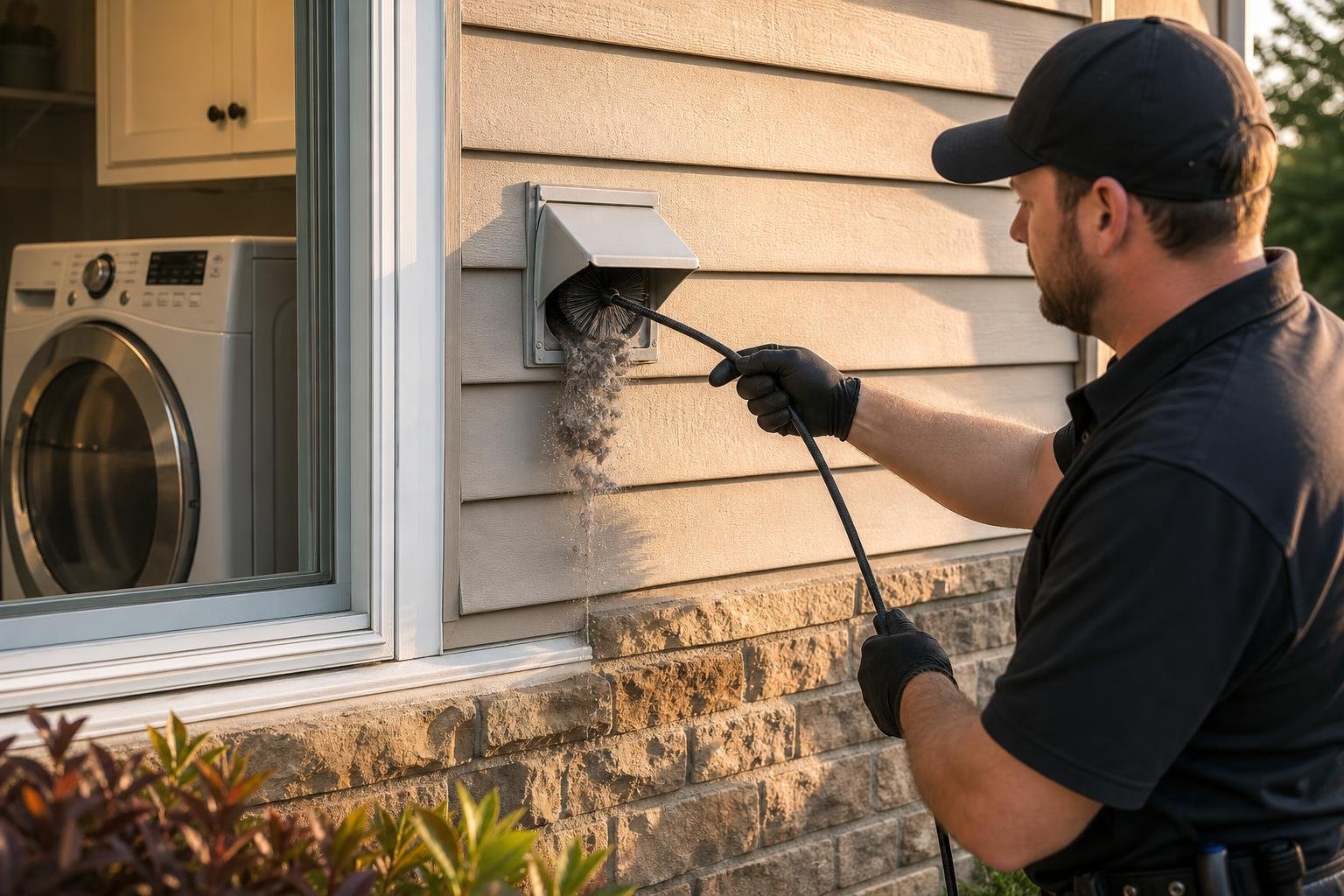
Quick AnswerA hot drum with damp clothes means the exhaust duct is restricted, not that the dryer is broken. Run it 5 to 10 minutes, then hold a hand under the outside hood: Whirlpool says weaker than a hair dryer on high means clean the vent. Vent work $80 to $300; appliance repair averages $180. Typical US ranges, not a quote.
Why Is My Dryer Not Drying?
Most of the time the dryer is fine and the air cannot get out. A restricted exhaust duct traps the moisture the dryer has already lifted out of the clothes, so the drum runs hot while the laundry stays damp. The next most common causes are a clogged lint screen, dirty moisture sensors and a failed heating element.
That ordering is not our opinion. It is the order the appliance makers themselves use. Whirlpool’s own Product Help page for a dryer that is not drying opens with the lint screen, moves to the vent, and only reaches “contact service” after nine other checks. Samsung’s troubleshooting page for long cycles reaches the same conclusion by a different route: check heat, clean the filter, run the vent blockage test, clean the exhaust, and consider service only “if the vent test passes and you suspect a defect.”
This matters because the two answers send you to different companies. A heating element or a control board is an appliance repair. A blocked, crushed, over-long or wrongly built duct is vent work, and no appliance technician will fix it. The rest of this guide is about telling those two apart before you pay either one of them.
Why Is My Dryer Getting Hot but Not Drying Clothes?
A dryer that gets hot but will not dry is the signature of an airflow problem, not a heat problem. Heat and airflow are two separate jobs: the element warms the air, and the blower pushes it through the clothes and out of the house carrying the moisture. Block the exhaust and you keep the heat but lose the removal.
Picture where the water actually goes. A washed load leaves the washer holding several pounds of water, and every ounce of it has to leave your house as vapour through a four-inch pipe. If that pipe is lined with lint, kinked behind the appliance, or ends at a hood whose damper is stuck shut, the vapour has nowhere to go. It condenses, the laundry re-absorbs it, and the cycle runs on.
Two tells confirm it. The laundry room gets humid or smells like hot fabric during a cycle, because the moisture is leaving through the cabinet instead of the duct. And the clothes come out hot and damp rather than cool and damp — cool and damp points at heat, hot and damp points at air.
How Do You Tell a Vent Problem From an Appliance Problem?
Use the heat as the test. If the drum gets hot and the clothes stay wet, suspect the vent. If the drum never gets warm at all, suspect the dryer — a heating element, thermal fuse, thermostat or gas igniter. If the cycle ends after ten minutes with wet clothes, suspect the moisture sensors.
Samsung publishes a quick way to settle the first branch: run a timed cycle with any eco setting switched off and feel inside after thirty seconds. Heat means the heating circuit is working, which rules out the expensive appliance parts and leaves airflow and sensors. No heat means the opposite, and that is the point at which an appliance technician is the right call rather than a vent cleaner.
The table below is the same logic laid out symptom by symptom. It is worth ten minutes before any phone call, because the two trades price differently and neither one can do the other’s job.
| What you observe | Most likely cause | Who fixes it | Typical cost |
|---|---|---|---|
| Drum hot, clothes still wet, cycle runs long | Restricted or blocked exhaust duct | Vent cleaning or duct work | $80–$300 |
| Drum never gets warm | Heating element, thermal fuse, thermostat or igniter | Appliance repair | $75–$350 |
| Cycle ends early, clothes damp | Dirty moisture sensors or dryness setting | Usually DIY | $0 |
| Laundry room humid or smells hot during a cycle | Moisture escaping the cabinet, not the duct | Vent cleaning or duct work | $80–$300 |
| Little or no air at the outside hood | Clogged duct, nest, or damper stuck shut | Vent cleaning | $80–$185 |
| Loud rumble or thumping with poor drying | Blower wheel, drum rollers or bearings | Appliance repair | $100–$400 |
| Clogs again within months of a cleaning | The duct itself is wrong, not just dirty | Duct replacement or reroute | $100–$500 |
How Do You Test Dryer Airflow Yourself?
Whirlpool publishes the simplest version and it costs nothing. Run the dryer for five to ten minutes, then go outside and hold your hand under the exhaust hood. Whirlpool’s threshold is explicit: if the air movement is less than a hair dryer on high speed, clean the lint from the entire length of the system and the exhaust hood.
Do three more checks while you are out there. Confirm the hood flap actually opens when the dryer runs, since a damper glued shut with lint stops the air no matter how clean the duct is. Look for lint on the siding below the hood, which means air is escaping but slowly. And check that nothing has nested inside the opening.
Many newer machines will do the test for you. Samsung dryers include a vent blockage test that displays its result for five minutes, and the codes CLg, Cg, C80 or C90 all indicate a clog. A Ct result just means the machine is too warm to judge: let it sit at room temperature for about an hour and run it again. Whirlpool models show the same finding as an AF code or a Check Vent light.
Can a Lint Screen Really Stop a Dryer From Drying?
Yes, and it is the first thing both Whirlpool and Samsung tell you to check. Whirlpool states plainly that a screen blocked by lint can increase drying time and that it is imperative to clean the screen after every use. Samsung calls the lint filter “the first place where moisture might get blocked.”
There is a second failure that looks like a clean screen. Dryer sheets and liquid fabric softener leave an invisible film across the mesh that passes lint but restricts air. The test takes ten seconds: run tap water onto the screen. If the water beads or sits on top instead of running straight through, the mesh is sealed. Scrub it with warm water, a little dish soap and a soft brush, then dry it before refitting.
Also check the slot the screen sits in. Lint that gets past the filter collects in the housing below, and a vacuum crevice tool clears it in a minute. None of this costs anything, which is why it belongs before any service call.
Why Is My Dryer Not Drying Well All of a Sudden?
Sudden onset points at a blockage or a broken part; gradual onset points at accumulation. A dryer that worked on Monday and failed on Tuesday usually has something new in the way — a nest, a collapsed transition duct, a damper stuck shut, or a failed component. Drying times that crept up over two winters are lint building up.
The distinction is genuinely useful because it narrows the search. Sudden failures are almost always at one of two places: directly behind the appliance, where a flexible transition duct gets crushed when the dryer is pushed back into place, or at the exterior termination, where birds and rodents build. Both are visible without tools.
Gradual decline is the case for a schedule rather than a diagnosis. Whirlpool advises that the venting from the dryer to the outside of the home must be cleaned every one to two years, or as needed when drying performance has decreased. Samsung says once or twice a year. If your drying times have doubled over a few seasons, you are simply overdue.
What Blocks a Dryer Vent?
Lint is the usual answer, but it is rarely alone. The four things technicians actually pull out of residential dryer ducts are compacted lint, bird and rodent nests, crushed or kinked flexible duct, and water-logged lint sitting in a low spot where the run sags. Each one restricts the same four-inch cross-section.
Nests are more common than people expect, because a dryer vent is a warm, sheltered cavity with an opening sized for exactly the sort of bird that wants one. They appear at the termination rather than deep in the run, which is why the outside check above finds them. Rodents work from the other direction and tend to shred the duct as well as fill it.
Wet lint deserves separate mention because it behaves differently. Dry lint brushes out; lint that has been soaked by condensation sets into a dense plug that has to be broken up. It forms where a duct runs through an unheated space or dips below the horizontal, and it is why a duct that sags is a recurring problem and not a one-off cleaning.
Is My Duct the Problem Rather Than the Lint?
If the vent clogs again within months of a professional cleaning, the duct itself is wrong. The 2021 International Residential Code caps a dryer exhaust run at 35 feet of developed length, and every four-inch mitered 90-degree elbow subtracts 5 feet from that budget while a 45 subtracts 2 feet 6 inches.
A real example of how fast that budget disappears: a 20-foot run with three 90-degree elbows has an equivalent length of 35 feet and is already at the limit. Add a fourth elbow and the installation is non-compliant, and it will keep collecting lint however often it is cleaned. Where the manufacturer publishes its own figures, those govern instead — Samsung, for instance, deducts six feet per 90-degree turn, which is stricter than the code table.
The other failures are material and shape. Code requires smooth-interior metal at least 0.0157 inch thick (No. 28 gage) in a 4-inch nominal diameter, with any flexible transition duct limited to a single UL 2158A length of no more than 8 feet. GE Appliances is blunter: rigid is preferred, plastic ducting is no longer approved, and white flexible plastic can contract at curves to less than 4 inches at a 90-degree turn, where “lint tends to build up in these areas and has caused fires in some cases.”
| Requirement | Code section | What the code says | Common fault |
|---|---|---|---|
| Duct diameter | M1502.4.1 | 4 inches nominal | Reducing to fit an undersized wall opening |
| Duct material | M1502.4.1 | Metal, smooth interior, 0.0157 in minimum | Plastic or foil used for the whole run |
| Transition duct | M1502.4.3 | Single UL 2158A length, 8 ft maximum, not concealed | Two lengths joined, or buried in a wall |
| Maximum length | M1502.4.6.1 | 35 ft developed, minus 5 ft per 90-degree elbow | Elbow count never counted against the limit |
| Termination clearance | M1502.3 | At least 3 ft from openings into the building | Venting beside a window or into a soffit |
| Backdraft damper | M1502.3 | Required at the termination | Damper present but seized shut with lint |
| Screens | M1502.3 | “Screens shall not be installed at the duct termination” | Insect mesh fitted over the hood |
| Fasteners | M1502.4.2 | No fastener protruding more than 1/8 in into the duct | Sheet-metal screws at every joint |
Two faults on that list cause more drying complaints than the rest combined. Sheet-metal screws through the joints give lint something to catch on at every connection, which is why the code limits protrusion to an eighth of an inch and why foil tape is the correct way to seal a dryer duct. And a screen over the hood — usually fitted with good intentions against insects — is explicitly prohibited, because it is a lint filter installed at the one point in the system nobody ever cleans.
Will a Booster Fan Fix a Dryer That Is Not Drying?
No, and in most of the United States it is not legal to install one. Section M1502.4.5 of the 2021 International Residential Code states that “domestic booster fans shall not be installed in dryer exhaust systems.” GE Appliances says the same in its own ducting guidance: booster fans are not approved for use on an individual dryer’s exhaust.
This is worth saying plainly because booster fans are sold and quoted as a fix, at roughly $150 to $400, and they are offered precisely to the people reading this page. A fan pushing air through a duct that is too long, too kinked or full of lint does not solve the restriction; it masks it while the lint keeps accumulating behind a device that was never listed for the job.
There is a narrow, genuine exception that is often confused with it. The code does permit a duct power ventilator — a listed dryer exhaust duct power ventilator, or DEDPV — where it conforms to UL 705 under M1502.4.4, and in that case the ventilator manufacturer’s instructions set the maximum duct length. That is a specific listed appliance for genuinely long runs, not the generic inline booster fan sold at hardware stores. If someone proposes a fan, ask which of the two it is and to see the listing.
Why Does My Dryer Stop Early With the Clothes Still Damp?
That is a sensor problem rather than an airflow problem. Automatic and sensor-dry cycles end when moisture bars inside the drum stop detecting damp fabric, and a film of fabric-softener residue across those bars makes dry clothes out of wet ones. Samsung’s fix is a soft cloth and a drop of dish soap.
Three related settings cause the same complaint without anything being broken. An eco or low-heat option reduces heat and lengthens cycles by design. A damp-alert feature signals at roughly 80 percent dry, and people unload at the beep rather than at the end. And most sensor cycles need a minimum load to work — Samsung puts it at about four regular bath towels — because one or two items can tumble clear of the sensors entirely.
Whirlpool adds a physical cause worth checking: if the dryer is not level, clothes may not contact the moisture sensors during automatic cycles. A spirit level on the top panel and a turn of the levelling feet rules it out in two minutes, and it costs nothing.
Can the Washer or the Load Be Causing It?
Yes, more often than people credit. A washer that is not reaching full spin speed hands the dryer laundry carrying far more water than it was designed for, and the result looks exactly like a dryer fault. An unbalanced or overloaded wash, a worn drive belt, or a clogged drain filter all cut spin speed.
Load size cuts both ways. Overloading the dryer leaves no room for air to move between items, so the outside of the load dries and the middle stays wet — a load should fill no more than about three-quarters of the drum. Underloading defeats the moisture sensors as described above. Mixed loads of heavy towels and light shirts are the worst case, since the cycle ends on whichever the sensors happen to be touching.
One honest check settles it. Run a single spun-out load of four or five bath towels on a timed cycle of 40 minutes. If that comes out dry, your problem is load composition or settings. If it comes out hot and damp, the problem is the machine or the vent, and the airflow test above tells you which.
What Does It Cost to Fix a Dryer That Is Not Drying?
It depends entirely on which side of the diagnosis you land. Vent work runs $80 to $300, and appliance repair averages $180 to $200. Angi puts the national average dryer repair at $180 with a typical range of $100 to $430, while HomeGuide reports $200 and $100 to $300. Typical US ranges, not a quote.
The cheapest outcome is also the most common one. A standard dryer vent cleaning costs $80 to $185 nationally, and the free checks earlier on this page — lint screen, water test, damper, airflow at the hood, sensor wipe, levelling — resolve a good share of complaints at no cost at all. That is the reason to spend ten minutes before booking anything.
Where the duct is the problem rather than the lint, Angi reports vent repair at $75 to $150 and vent replacement at $100 to $300, and advises budgeting an extra $150 to $300 for vent work alongside a repair. Rerouting a run that was never compliant is the one job that ends a recurring bill rather than deferring it.
| Fix | Typical cost | Reported by |
|---|---|---|
| Clean the lint screen and sensors yourself | $0 | Whirlpool, Samsung guidance |
| Professional dryer vent cleaning | $80–$185 | Angi, HomeGuide |
| Dryer vent repair | $75–$150 | Angi, Sep 2026 |
| Dryer vent replacement or reroute | $100–$300 | Angi, Sep 2026 |
| Bird or rodent nest removal | $120–$400 | Angi, HomeGuide, Fixr |
| Heating element replaced | $100–$350 | Angi, Sep 2026 |
| Thermal fuse replaced | $75–$150 | HomeGuide |
| Thermostat replaced | $100–$300 | HomeGuide |
| Motor replaced | $150–$400 | HomeGuide |
| Control board replaced | $250–$500 | HomeGuide |
| Service call or diagnostic fee | $50–$130 | Angi, HomeGuide |
One figure in that table is worth reading twice. The parts themselves are cheap — Angi lists a thermal fuse at $5 to $18 and a thermostat at $15 to $60 — and almost all of an appliance repair bill is the visit and the labour, at $50 to $125 an hour plus a service call of $50 to $130. That is exactly why the free diagnosis matters: the wrong first phone call costs you a service call before anyone has looked at the duct.
Should I Repair or Replace a Dryer That Will Not Dry?
The working rule both cost publishers give is the 50 percent test: if the repair costs more than half the price of a new machine, replace it. HomeGuide puts a new dryer at $800 to $1,200 for the unit, which sets the break-even for a repair at roughly $400 to $600.
Age sharpens it. HomeGuide suggests replacing a dryer over six to ten years old that needs frequent repairs, and repairing one under four to six years old that needs a single minor fix. Angi adds that a broken drum, compromised wiring or a faulty control board usually favours replacement, and a control board at $250 to $500 on an eight-year-old machine is a clear case.
The trap here is replacing the dryer when the duct was the problem. A new machine vented into the same restricted 35-foot run with four elbows will dry badly too, and the complaint will reappear within weeks. Settle the airflow question before spending $800, not after.
Is a Dryer That Is Not Drying a Fire Risk?
Treat it as one. The US Fire Administration records about 2,900 residential clothes dryer fires a year, causing 5 deaths, 100 injuries and $35 million in property loss — and failure to clean is the leading factor contributing to ignition, at 34 percent. Poor drying is the early symptom of exactly that condition.
Divide the loss figure by the fire count and the arithmetic is stark: $35 million across 2,900 fires is roughly $12,000 of average property loss per fire, against $80 to $185 for the cleaning that removes the cause. That division is ours, shown so you can check it; the two totals are the USFA’s published figures for 2008 to 2010.
An independent data set agrees on the cause. NFPA attributes 29 percent of home dryer and washer fires to failure to clean, with dust, fibre or lint the item first ignited in 27 percent of dryer fires. USFA also records that 83 percent of these fires start in the laundry area and that incidence peaks in January, at 11 percent — the month dryers run hardest and windows stay shut.
When Should You Stop Troubleshooting and Call a Pro?
Stop when the free checks are done and the dryer still runs hot and damp. That means the lint screen is clear and water runs straight through it, the sensors are wiped, the machine is level, the load is reasonable, the hood damper opens — and the airflow outside is still weaker than a hair dryer on high.
Four situations should skip the DIY stage entirely. A burning or hot-fabric smell during a cycle, a gas dryer you would have to disconnect to reach the duct, a vent that terminates on the roof, and a duct you cannot see the far end of. The first is a fire-risk symptom; the other three are jobs where the DIY route trades money for genuine risk.
When you do call, say what you found. “Hot drum, wet clothes, almost no air at the outside hood” books the right visit. The trade certification to ask for on the vent side is the Chimney Safety Institute of America’s Certified Dryer Exhaust Technician credential, and a company that cleans the full duct run from both ends should be willing to put the scope and the flat fee in writing before starting.
Dryer Not Drying? Your Local Team
If you are in or around Nashville, Cincinnati, Cleveland or Minneapolis, our technicians test airflow at the hood, clean the full duct run from both ends, free the backdraft damper, and tell you plainly when the problem is the appliance rather than the duct — with a flat fee in writing before any work starts. Choose your city below for local details and booking.
Nashville, TN · Cincinnati, OH · Cleveland, OH · Minneapolis, MN
FAQs
Most often the exhaust duct is restricted, so the moisture the dryer lifts out of the clothes cannot leave the house. A clogged lint screen, dirty moisture sensors and a failed heating element are the next most common causes. Whirlpool and Samsung both check the lint screen and the vent before any part.
Heat and airflow are separate jobs. The element warms the air and the blower pushes it out of the house carrying the moisture, so a blocked duct keeps the heat but loses the removal. Hot and damp clothes point at the vent; cool and damp clothes point at the heating circuit.
Sudden onset usually means something new is in the way: a bird nest at the termination, a transition duct crushed when the dryer was pushed back, a damper stuck shut, or a failed part. Drying times that crept up over two or three winters are lint accumulation instead, and the duct is simply overdue.
Run the dryer five to ten minutes, then hold your hand under the outside exhaust hood. Whirlpool's threshold is that if the air movement is less than a hair dryer on high speed, the system needs cleaning. Many Samsung dryers also run a vent blockage test, where CLg, Cg, C80 or C90 all indicate a clog.
Use the heat as the test. A hot drum with wet clothes points at the vent, because the heating circuit is clearly working. A drum that never gets warm points at the dryer, meaning a heating element, thermal fuse, thermostat or igniter. A cycle that ends early points at the moisture sensors.
Vent work runs $80 to $300 and appliance repair averages $180 to $200. Angi puts the national average dryer repair at $180 with a typical range of $100 to $430; HomeGuide reports $200 and $100 to $300. A standard vent cleaning is $80 to $185. These are typical US ranges, not a quote.
No, and the code prohibits it. Section M1502.4.5 of the 2021 International Residential Code states that domestic booster fans shall not be installed in dryer exhaust systems, and GE Appliances says the same. A listed UL 705 duct power ventilator is a different, permitted device for genuinely long runs.
Apply the 50 percent test: replace the machine if the repair costs more than half the price of a new one. HomeGuide puts a new dryer at $800 to $1,200, setting the break-even near $400 to $600. First settle whether the duct is the problem, or a new dryer will dry just as badly.
Sources and Standards Cited
Every dollar figure on this page is a published national range, with the publisher and its data date named inline. They are typical US ranges, not our quotes. The troubleshooting order and the airflow test come from the appliance manufacturers' own support documentation; duct construction requirements are from the 2021 International Residential Code; fire statistics are from the US Fire Administration and NFPA.
- Whirlpool Product Help, Dryer Not Drying — the lint screen checked first, the hand-under-the-hood airflow test against “a hair dryer on high speed”, the AF code and Check Vent light, home venting cleaned every one to two years, and dryer levelling for moisture-sensor contact. Checked October 2026.
- Samsung Support, Dryer Is Not Drying Clothes or Takes Too Long — the built-in vent blockage test and its CLg, Cg, C80, C90 and Ct results, the metal-not-foil requirement, six feet deducted per 90-degree turn, moisture-sensor cleaning, the roughly four-bath-towel minimum load, and service only after the vent test passes. Checked October 2026.
- GE Appliances, Dryer Installation Information for Exhaust Ducting — 4-inch round duct only, rigid preferred, semi-rigid and foil limited to 8 feet, plastic no longer approved, “never install a screen or grid of any kind”, no termination into a chimney, attic or crawl space, and booster fans and DEDPVs not approved on an individual dryer. Checked October 2026.
- 2021 International Residential Code, Chapter 15, Section M1502 Clothes Dryer Exhaust — M1502.1 manufacturer's instructions govern; M1502.3 termination at least 3 feet from openings, backdraft damper required, “screens shall not be installed at the duct termination”; M1502.4.1 metal of at least 0.0157 inch, smooth interior, 4-inch nominal diameter; M1502.4.3 transition duct a single UL 2158A length of at most 8 feet; M1502.4.4 duct power ventilators to UL 705; M1502.4.5 “domestic booster fans shall not be installed in dryer exhaust systems”; M1502.4.6.1 maximum 35 feet developed length, less 5 feet per 4-inch mitered 90-degree elbow and 2 feet 6 inches per 45.
- 2021 Seattle Residential Code, Chapter 15 (PDF) — the adopted copy of IRC Chapter 15 used to verify the Section M1502 wording quoted above. Local amendments vary, so check the code adopted where you live.
- US Fire Administration, Clothes Dryer Fires in Residential Buildings (2008–2010) — 2,900 fires, 5 deaths, 100 injuries and $35 million in loss per year; failure to clean the leading factor contributing to ignition at 34 percent; 83 percent start in the laundry area; January peak at 11 percent.
- NFPA, Clothes Dryer and Washing Machine fire fact sheet — 17,700 reported home structure fires involving dryers or washers, 15 deaths, 360 injuries, $194 million in direct damage; dryers 92 percent of these fires; failure to clean 29 percent; dust, fibre or lint first ignited in 27 percent of dryer fires.
- Angi, Dryer Repair Cost, updated September 2026 — national average $180, typical $100 to $430; service call $50 to $80; labour $50 to $100 per hour; vent repair $75 to $150 and vent replacement $100 to $300; thermal fuse $5 to $18, thermostat $15 to $60, motor $60 to $150, control board $90 to $280 as parts.
- Angi, Cost to Replace a Heating Element in a Dryer, updated September 2026 — $100 to $350 nationally; electric dryers $90 to $250, gas dryers $100 to $350; labour $60 to $150 per hour.
- HomeGuide, Dryer Repair Cost — average $200, typical $100 to $300, span $70 to $500; labour $50 to $125 per hour; minimum service fee $70 to $130; installed heating element $150 to $350, thermal fuse $75 to $150, thermostat $100 to $300, motor $150 to $400, control board $250 to $500; new dryer $800 to $1,200.
- Angi, How Much Does Dryer Vent Cleaning Cost, updated July 2026 — national average $145, span $75 to $340, and nest removal $120 to $250, used for the vent-side figures.
- HomeGuide, Dryer Vent Cleaning Cost — average $130, typical $80 to $185, 30 to 60 minute job duration.
- Chimney Safety Institute of America, Certified Dryer Exhaust Technician — the trade certification to ask for when hiring on the vent side.