
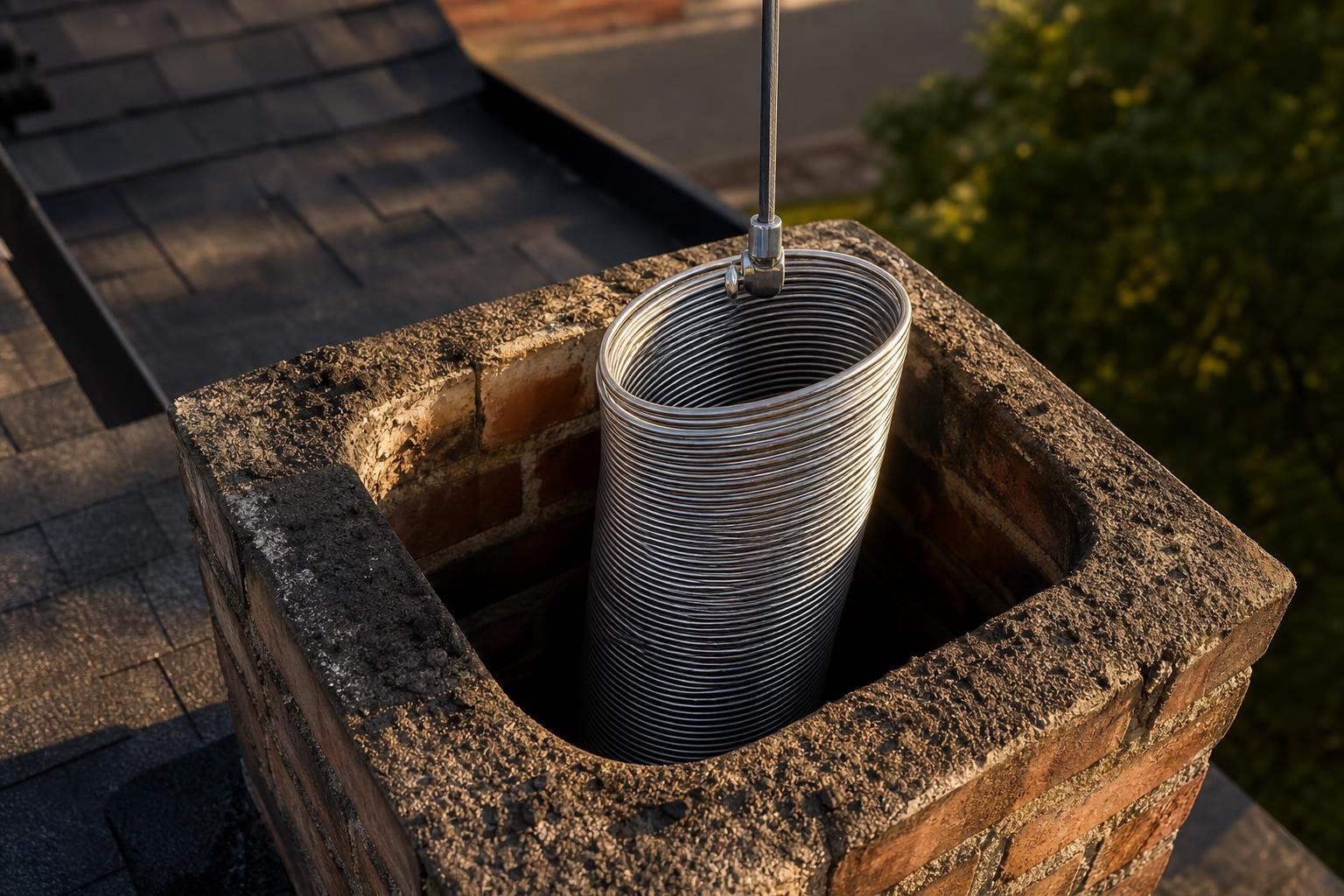
Most relining jobs call for a stainless steel liner, but some chimneys need a different approach entirely. A cast-in-place liner is a lightweight, insulating cementitious mixture that we pump or trowel around a removable form inside the existing flue, then let cure into a smooth, seamless new interior surface molded to the exact shape of your chimney. Rather than inserting a separate tube inside a damaged flue, it becomes part of the chimney structure itself.
We turn to this method for the flues a flexible steel liner can't solve on its own — chimneys with irregular shapes, offsets, or bends that a rigid or flexible sleeve won't seat into cleanly, and older masonry chimneys around your area where the interior clay tile has deteriorated so extensively that the surrounding brick and mortar have also lost structural integrity. In those cases, a cast liner does double duty: it forms the new smooth flue passage, and it bonds to and reinforces the weakened masonry around it, which a steel liner sitting loose inside the flue simply can't do.
What's Included
- Video inspection first. We confirm the flue's condition and shape with a camera scan before recommending a cast-in-place approach.
- Removable form insertion. A form is lowered into the flue to shape the new interior passage as the mixture is applied.
- Insulating cementitious pour. The mixture is pumped or troweled around the form, bonding to and reinforcing the surrounding masonry.
- Cure time. The new liner is left to cure fully before the chimney is put back into service.
- Final camera check. A follow-up video scan confirms the cured liner is smooth, continuous, and ready for use.
When Cast-in-Place Beats a Flexible Liner
The deciding factor is almost always the condition and shape of the existing flue, not personal preference. If a video inspection shows a straightforward, reasonably intact flue, a flexible or rigid stainless steel liner is faster and less expensive, and it's what we'll usually recommend. But on older homes where the clay tile has crumbled extensively, where the flue has an unusual offset, or where the surrounding masonry itself needs structural reinforcement rather than just a new interior surface, cast-in-place is the option that actually addresses the root problem instead of masking it. We'll show you the camera footage and explain exactly why one approach makes more sense than the other for your specific chimney.
Get a Written Quote for Your Liner
FAQs
A stainless steel liner is a manufactured tube fed down the flue, while a cast-in-place liner is a cementitious mixture pumped or troweled around a removable form to create an entirely new interior surface molded directly to your chimney. Cast-in-place is the better fit when the flue itself is irregularly shaped or so deteriorated that a steel sleeve wouldn't seat properly or solve the underlying structural problem.
It reinforces the masonry from the inside, which helps stabilize a structurally weakened chimney, but it doesn't repair exterior brick, mortar joints, or a damaged crown. If a video inspection or a look from the ground shows cracked or spalling brick on the outside, that typically needs a separate masonry repair or rebuild alongside the relining work.
The pour and form removal itself is usually done in a day, but the cementitious material needs time to fully cure before the chimney is put back into service. We'll give you a specific timeline for your job based on the length of the flue and the product used, and we don't sign off on the work until a final camera check confirms the liner is ready.