
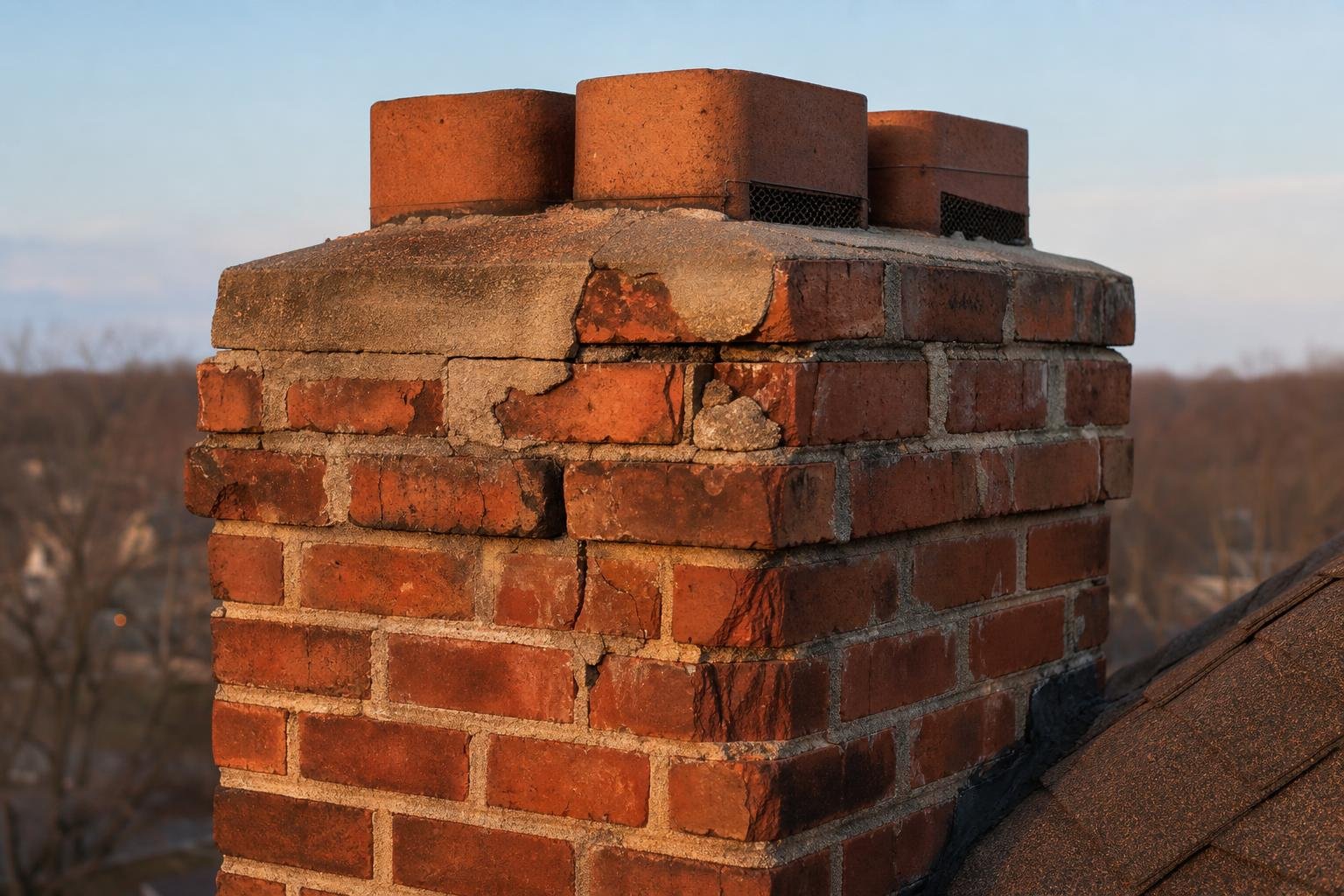
The crown is the sloped concrete or mortar cap at the very top of the chimney, and it does more work than most homeowners realize. It's the first line of defense against rain, sitting directly above the flue, sealing the top of the masonry, and shedding water off to the sides instead of letting it pool and soak in. When a crown is sound, it can last decades. When it isn't, it's usually because it was never built right in the first place — poured flat instead of sloped, mixed from ordinary concrete instead of a proper crown mix, or lacking the overhang past the brick face that keeps water off the sides of the stack.
A crown rebuild is what we recommend once a crown has moved past the point where a patch or sealant coating will hold. That usually means multiple cracks running through the surface, chunks broken off entirely, a wash that no longer sheds water because the slope has eroded away, or a crown that was poorly built from the start and is failing early as a result. In any of those situations, the honest fix isn't another patch on top of a failing surface — it's demolishing the crown down to the brick and pouring a proper one in its place.
We see a lot of this on older homes throughout East Nashville, Inglewood, and Donelson, where original crowns were often poured decades ago with whatever mix was on hand at the time, long before crown-specific mortar mixes and proper wash design were standard practice.
What's Included in a Crown Rebuild
- Full demolition. Removing the failed crown completely down to the top course of brick, rather than pouring new material over compromised old material.
- Wire mesh reinforcement. Reinforcing the new pour so it resists the cracking that comes from ordinary temperature and moisture cycling.
- Proper overhang & slope. A 2-to-3-inch overhang past the brick face and at least a quarter-inch-per-foot slope, so water sheds off the sides instead of running down the stack.
- Written flat-fee estimate. A clear price before demolition starts, based on crown size and the condition of the brick underneath.
Crown Repair vs. Crown Rebuild: How We Decide
We don't default to the bigger job. If your crown has a single hairline crack and the rest of the surface and slope are intact, a crown repair — cleaning the crack and sealing it with a flexible waterproof sealant — is the right, less expensive fix, and we'll tell you that plainly. A rebuild is reserved for crowns that are past patching: widespread cracking, missing sections, a wash that's lost its pitch, or a crown that was poured with the wrong materials or slope to begin with and is likely to keep failing no matter how many times it's patched. On the inspection, we'll show you exactly what we're seeing and explain honestly which category your crown falls into before recommending either service.
Get a Free Crown Rebuild Estimate
FAQs
A single hairline crack that hasn't let water reach the flue or brick below can usually be sealed with a repair. A rebuild is the right call once the crown has multiple cracks, missing chunks, a wash that's lost its slope, or was poured with the wrong mix or pitch to begin with. At that point, patching won't hold up to another freeze-thaw cycle.
We demolish the failed crown down to the top course of brick, then form and pour a full replacement with a proper 2-to-3-inch overhang past the brick face and at least a quarter-inch-per-foot slope, reinforced with wire mesh. That combination of overhang and slope is what actually sheds rainwater away from the masonry instead of letting it pool and seep back in.
In most cases, yes, if the crown was the actual source. A failed crown is one of the most common reasons water shows up inside a fireplace or chimney chase, since it sits directly above the flue. We'll confirm the crown is the culprit, rather than a cap, flashing, or chase cover issue, before recommending a rebuild.