
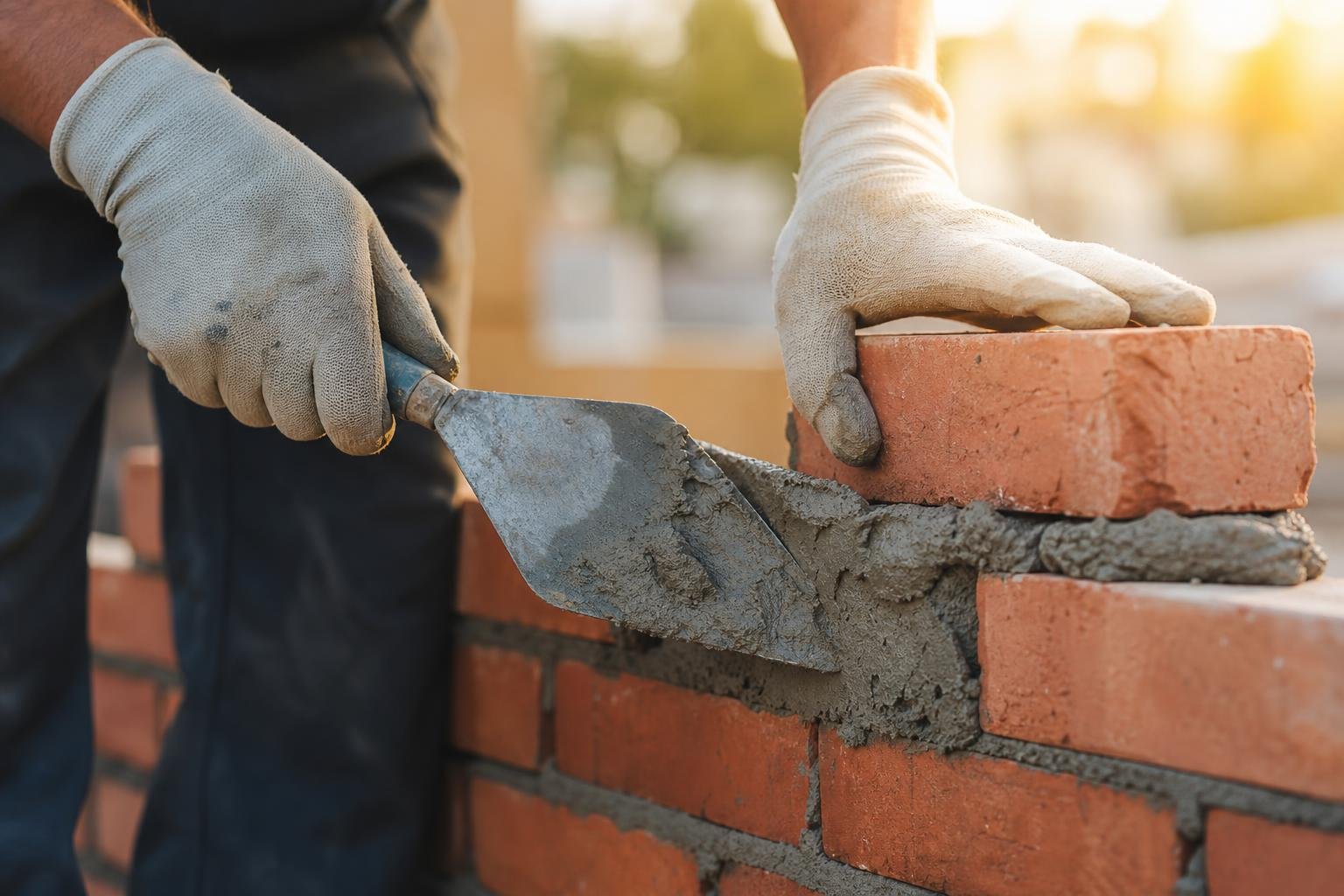
Quick AnswerTuckpointing is cutting deteriorated mortar out of masonry joints and packing in fresh mortar. In American usage it means the same thing as repointing — Brick Industry Association notes that ASTM E2260 treats the two as synonymous. The mortar matters more than the mason’s speed: repointing mortar is typically ASTM C270 Type N, O or K, and its strength should be similar to or weaker than the existing mortar. Joints are cut to 2 to 2½ times their width — about ½″ to 1″ on brick. A chimney runs $500 to $2,500, a typical US range and not a quote.
What Is Tuckpointing?
Tuckpointing is the repair of mortar joints in brick or stone masonry: the deteriorated mortar is cut out of the joints to a measured depth and fresh mortar is packed in. In American usage it covers the whole job. The brick is not replaced and the wall is not rebuilt.
The work has three steps that matter and one that does not. Cutting out the old mortar to depth, mixing a compatible replacement, and compacting it in layers are the three; the colour match that homeowners judge the job by is the one that has nothing to do with whether it lasts. Brick Industry Association describes the sequence as removal of defective mortar followed by placing mortar into a properly prepared joint — and the phrase “properly prepared” is doing most of the work in that sentence.
On a chimney it is maintenance, not reconstruction. A stack whose joints have eroded but whose brick is sound is a tuckpointing candidate. A stack whose brick faces have popped off, or that has started to lean, is not — and the distinction is the single most useful thing to settle before anyone quotes a price.
Tuckpointing vs Repointing: Is There Actually a Difference?
Yes and no. ASTM E2260, the standard guide for the work, defines tuckpointing as synonymous with repointing, and that is how the American trade uses both words. Historically they were different: tuckpointing was a decorative raised ribbon of lime putty laid over a flush joint, not a structural repair.
The National Park Service is blunt about the slippage, calling the job “repointing, also known simply as ‘pointing’ or — somewhat inaccurately — ‘tuck pointing’”, and noting in a footnote that tuckpointing “technically describes a primarily decorative application of a raised mortar joint or lime putty joint on top of flush mortar joints.” Its pointing-style section repeats the point: tuckpointing is not true repointing.
This matters commercially, because the price publishers have not settled it either and they contradict each other about which word is the expensive one. Read any quote by what the contractor will physically do to the joints, not by which of the two words appears on it.
| Source | Its position on the word | What that implies for a quote |
|---|---|---|
| ASTM E2260 (as cited by the Brick Industry Association) | Tuckpointing is synonymous with repointing | The standards world treats them as one job |
| Brick Industry Association, Brick Brief, July 2005 | Titles its guidance “Repointing (Tuckpointing) Brick Masonry”; notes the older decorative sense | Industry guidance covers both names |
| National Park Service, Preservation Brief 2 | “Tuck pointing” is a somewhat inaccurate name for repointing; true tuckpointing is a decorative raised or lime-putty joint | On historic brick, insist the scope is described, not named |
| Angi, updated 9 July 2026 | Traditional tuckpointing uses two mortar colours, but in North America the word usually just means removing and replacing mortar | Expect a plain mortar-replacement scope |
| Fixr, updated 18 August 2022 | Treats tuckpointing as the aesthetic upgrade and repointing as structural maintenance — and prices tuckpointing higher | Two publishers, opposite definitions: check the scope |
How Do You Know a Chimney Needs Tuckpointing?
Mortar that has eroded more than a quarter inch back from the brick face is the Brick Industry Association’s own threshold. Add crumbling or sandy joints that give way to a key scraped along them, open voids, hairline cracks between brick and mortar, white efflorescence, and loose or shifting brick.
The BIA’s diagnostic method is one a homeowner can copy: visual observation in combination with light scraping with a metal tool detects cracked, spalled and friable joints, and it names erosion over ¼ inch (6.4 mm) as a condition to act on. That is a measurement, not an impression, and it is the number to take to a ladder — or to a photograph taken from the ground with a long lens.
The reason to act on it is water, and water is the expensive failure mode in a house. Water damage and freezing accounted for 22.6 percent of all US homeowners insurance losses in 2023, according to Triple-I citing ISO, a Verisk Analytics business, second only to wind and hail at 42.5 percent. Average claim severity for that category was $15,400 across 2019 to 2023 at 1.50 claims per 100 house years. Against a $500 to $2,500 chimney repoint, that average claim is roughly six to thirty times the repair — our arithmetic on Triple-I’s published average and the published repair ranges, not a figure either source states.
Open joints are also one of the items a sweep is looking for during the annual check that NFPA 211 calls for, which is the cheapest way to catch them. Our guide to what each inspection level costs and includes sets out what gets examined at each one.
Why Does the Mortar Fail Before the Brick Does?
Because it is designed to. Mortar joints are sacrificial: they are meant to be softer and more permeable than the brick so that moisture and movement are absorbed by the joint rather than the unit. The Brick Industry Association puts typical joint life above 25 years and brick life beyond 100.
That is a deliberate four-to-one trade. The BIA states that a lifespan exceeding 25 years is typical for mortar joints while the longevity of brick units, however, may well exceed 100 years — so a brick chimney is expected to need its joints renewed two or three times before the brick is spent. The National Park Service makes the mechanism explicit, describing mortar as intended to be sacrificial: it takes the freeze-thaw cycling, the thermal movement and the moisture transfer so the units do not.
Which is why the right reading of an eroded joint is not “something went wrong” but “the joint did its job and is now due”. The failure worth investigating is a joint that has gone in well under 20 years, because that usually means water is being delivered to it by something else — a cracked crown, a missing cap, or failed flashing at the roofline.
What Mortar Should Be Used for Tuckpointing?
Not the strongest one. The Brick Industry Association says repointing mortar is typically ASTM C270 Type N, O or K, and that its compressive strength should be similar to or weaker than the existing mortar. The National Park Service calls assuming that hardness means quality a common error.
The NPS wording is worth quoting exactly, because it inverts what most people assume they are buying: “Mortars for repointing should be softer or more permeable than the masonry units and no harder or more impermeable than the historic mortar to prevent damage to the masonry units”, and “It is a common error to assume that hardness or high strength is a measure of appropriateness.” The BIA agrees from the industry side, giving typical repointing proportions by volume of roughly 1:1:6 for Type N, 1:2:9 for Type O and 1:4:15 for Type K cement, lime and sand.
Note also what the NPS says about the convenient option: masonry cements generally are not recommended for use on historic masonry buildings. If a contractor cannot say which ASTM C270 type they are mixing and why it suits the existing mortar, that is the question to press before the price.
| Type | Compressive strength | Typical proportions (cement:lime:sand) | Role in tuckpointing |
|---|---|---|---|
| Type M | 2,500 psi | Highest cement content of the five | Not a repointing mortar; too hard for most existing masonry |
| Type S | 1,800 psi | High cement content | Rarely appropriate for repointing older brick |
| Type N | 750 psi | About 1:1:6 | BIA: one of the three typical repointing mortars |
| Type O | 350 psi | About 1:2:9 | BIA: typical repointing mortar for softer masonry |
| Type K | 75 psi | 1:3:10 per NPS; about 1:4:15 per BIA | Softest option; proportions now sit in ASTM C270’s repointing appendix |
The two sources differ on Type K’s proportions — the NPS gives 1-3-10 and the BIA about 1:4:15 — and both are reported here rather than averaged. The lime itself has a specification too: for repointing, the NPS says lime should conform to ASTM C207, Type S or Type SA, Hydrated Lime for Masonry Purposes, lime putty to ASTM C5, and portland cement to ASTM C150.
What Happens When the Mortar Is Too Strong?
The brick breaks instead of the joint. A mortar stronger in compressive strength than the masonry units will not give, so stress is relieved through the brick as cracking and spalling. The National Park Service documents walls where hard portland-cement mortar trapped moisture until it popped the faces off the bricks.
Its description of the mechanism is the clearest published account of why cheap-and-hard repointing is worse than leaving the joints alone: “A mortar that is stronger in compressive strength than the masonry units will not ‘give’”, with the result being “permanent damage to the masonry, such as cracking and spalling, that cannot be repaired easily”. Alongside a photographed failure it records that moisture trapped in the wall “was unable to evaporate through the mortar which is intended to be sacrificial” and “remained in the walls until water pressure eventually popped the surface off the bricks”.
That is not a reversible mistake. Mortar can be cut out again; a spalled brick face cannot be put back, and on a chimney the spalling tends to concentrate near the top where the masonry is wettest and coldest. A hard mix sold as the durable option is the one repair on this page that can turn a maintenance item into a rebuild of the upper stack.
How Deep Does the Old Mortar Have to Be Cut Out?
Two to two and a half times the width of the joint, per the National Park Service, which for most brick joints means half an inch to one inch. The Brick Industry Association sets the floor at twice the joint thickness. Surface skim coats over sound-looking joints are not tuckpointing.
The NPS gives both the ratio and the reason: old mortar “should be removed to a minimum depth of 2 to 2-½ times the width of the joint to ensure an adequate bond and to prevent mortar popouts”, which “for most brick joints… will require removal of the mortar to a depth of approximately ½ to 1 inch”; stone masonry with wide joints may need several inches. The BIA states the industry minimum as depth that “should equal or exceed two times the mortar joint thickness”.
This is the specification a homeowner can actually verify, and the one that separates a repair from a cosmetic smear. Ask to see a raked-out section before any new mortar goes in. A joint that has been cut to depth looks alarming — a clean dark channel between bricks — and that is what correct preparation is supposed to look like.
Are Angle Grinders Safe to Use for Tuckpointing?
Only on horizontal joints, and only in hard portland-cement mortar. The National Park Service permits thin diamond-bladed grinders there and says they should never be used on vertical joints because of the danger of slipping. On soft brick in unskilled hands it calls power tools disastrous.
The full position is narrow and worth holding a contractor to. The traditional method is “hand chisels and mash hammers”; “the use of power tools by unskilled masons can be disastrous for historic masonry, particularly soft brick”; “using power saws on walls with thin joints, such as most brick walls, almost always will result in damage”; thin diamond-bladed grinders “may be used to cut out horizontal joints only on hard portland cement mortar” and “should never be used on vertical joints because of the danger of slipping”. Small pneumatically powered chisels, by contrast, “generally can be used safely and effectively”.
Set that against the economics. HomeGuide prices grinder work from $3 to $5 per square foot against hand work up to $25, and says power tools may be used only on horizontal joints wider than ½″; Fixr notes contractors using electric grinders can come in around 20 percent cheaper. The cheapest line on a tuckpointing quote is often the method the preservation guidance restricts most tightly — which is a trade-off worth making knowingly rather than by accident.
How Much Does Tuckpointing Cost?
Five to twenty-five dollars per square foot is the range all three major price publishers land inside, and HomeGuide puts the national average at $1,200 across 258 reported projects in February 2026. These are typical US ranges, not a quote; height, mortar type and access move them more than anything else.
Each publisher is named with its data date below, and none of the figures are blended together. Where they disagree, the disagreement is reported rather than averaged into a number that no source actually publishes.
| Publisher | Data date | Average | Per square foot | Chimney | Labour |
|---|---|---|---|---|---|
| HomeGuide | 9 February 2026 | $1,200 (258 reported projects); typical $500–$2,500 | Tuckpointing $5–$25; repointing brick $3–$20; above 8′ $8–$30 | Tuckpointing $8–$30/sq ft, or $500–$2,500; repointing $20–$50 per row | $50–$125/hr; labour up to 90% of total |
| Angi | 9 July 2026 | No national average published for this scope | About $10/sq ft on a chimney | $500–$2,500 | No rate published in this article |
| Fixr | 18 August 2022 | $2,000; typical $1,500–$2,500 | $5–$10 up to 8′; $10–$25 above | $500–$2,500; a 20 sq ft chimney area $200–$500 | $75–$125/hr; labour 50% or more of total |
Two cost drivers show up in all three. Height: HomeGuide adds 20 to 40 percent above 8′, and Fixr roughly doubles its per-foot rate over the same threshold. Material: Fixr prices the mortar itself at $5–$10 per bag project for Type M against $20–$50 for Type O, and lime putty work at $600–$2,250 against cement at $500–$2,000 — so the softer, more appropriate mortar is also the dearer one, which is worth knowing before a cheaper mix is proposed as a favour.
How Much Does It Cost to Tuckpoint a Chimney?
Five hundred to two thousand five hundred dollars. That is the one figure Angi, HomeGuide and Fixr all publish identically for a chimney, despite disagreeing on almost every other number. Per square foot the chimney rate runs higher than a wall: roughly $8 to $30, because everything happens at height.
Three independent publishers converging on an identical range is unusual in this category and makes $500 to $2,500 the most defensible single number on this page. Above it, HomeGuide prices two-storey or complex stacks at $5,000 to $7,000; below it, Fixr puts a 20 square foot chimney area at $200 to $500 and about four hours for one mason, and a fireplace face at $100 to $500. Fixr also notes chimney work can cost up to two times more than equivalent wall area because of ladders and scaffolding.
What moves a real chimney quote inside that range is how much of the stack is involved — the top few courses above the roofline weather worst and are often the only part that needs cutting out — plus access, and whether the crown and cap are being dealt with in the same visit. Our chimney cap and crown cost guide covers the two items most often bundled with a repoint.
Why Do Published Tuckpointing Prices Disagree So Much?
Because the three publishers are not pricing the same job, or even the same word. One measures by square foot, one offers a linear-foot alternative, one prices chimney work by the row. Hand work and grinder work differ by about twenty percent, and height alone adds twenty to forty.
The unit is the biggest source of confusion. HomeGuide says masons charge by the square foot and publishes no linear-foot price at all; Fixr publishes $1 to $5 per linear foot while calling that basis uncommon, and gives the conversion it uses — about 5.5 linear feet of joint per square foot of standard modular brick wall; HomeGuide prices chimney repointing at $20 to $50 per row. Those three bases cannot be compared without doing the arithmetic, and no publisher does it for you.
Then there is the word itself. Fixr prices tuckpointing at $5–$25 per square foot and repointing at $3–$15, treating the first as the aesthetic upgrade; HomeGuide prices tuckpointing at $5–$25 and repointing brick at $3–$20 while defining the terms differently again. So part of the spread between publishers is not a price difference at all — it is two publishers using one word for two different scopes. The question that cuts through it: how deep will the joints be cut, by what tool, and which ASTM C270 mortar type is going back in?
Is Tuckpointing a DIY Job?
On a low garden wall, sometimes. On a chimney, no. The work is at height, the mortar has to be matched rather than bought, the cut-out depth is measured not eyeballed, and the wrong mix damages brick permanently. Angi limits the DIY case to small, purely cosmetic fixes.
Matching is the part that is hardest to improvise, and it is quantifiable: HomeGuide prices laboratory mortar composition analysis at $300 to $500 and colour analysis at $150 to $325, which is what matching properly actually costs when the existing mortar is unknown. Lime mortar runs $30 to $70 a bag covering about 40 square feet. None of that is exotic — it is simply not what a hardware-store bag of premixed mortar does.
The other half is that a chimney repoint happens on a roof. Angi’s guidance is that homeowners “may be able to do tuckpointing projects on their own, especially for small, purely cosmetic fixes” but that chimney walls have to be done correctly for safety and roof work is dangerous, so “it’s best to hire a qualified local chimney repair professional”.
Does Tuckpointing Repair the Flue Inside the Chimney?
No. Tuckpointing renews the outside mortar joints between the brick. The flue liner inside is a separate assembly, and the code requires clay flue liners to be laid in medium-duty water-insoluble refractory mortar conforming to ASTM C199, which is not the mortar used on the exterior joints.
The International Residential Code keeps the two apart explicitly. R1003.12 requires that “clay flue liners shall be laid in medium-duty water insoluble refractory mortar conforming to ASTM C199”, and the same refractory specification governs firebrick in the firebox under R1001.5 and the parged smoke chamber under R1001.8. Nothing in a tuckpointing scope touches any of those surfaces.
This is the most common misunderstanding we are asked about after a quote. A repointed exterior does not make an unlined or cracked flue safe to use, and it is not a substitute for the liner work — our chimney liner cost guide covers that side. The two repairs are often needed together on an older chimney, and they are priced separately because they are different trades on different materials.
When Is a Chimney Too Far Gone to Tuckpoint?
When the brick itself has failed, the stack leans, or the wall section is no longer sound. Code sets masonry chimney walls at not less than four inches nominal thickness, so joints raked deep into a thin, spalled wall leave little to bond to. Then it is a rebuild.
The code gives the dimension to think with. R1003.10 requires that “masonry chimney walls shall be constructed of solid masonry units or hollow masonry units grouted solid” with “not less than a 4-inch (102 mm) nominal thickness”, and R1003.1 defines a masonry chimney as one built of solid or grouted-solid units, anchored, supported and reinforced as the chapter requires. A joint cut to ½″ or 1″ into a nominal 4″ wythe is routine; the same cut into brick that is already spalling and losing face is not.
Local amendments to the code do vary, so check what your jurisdiction has adopted. The text quoted here is the 2021 International Residential Code as adopted and published by the City of Seattle, because the ICC’s own full text is paywalled.
| What you are seeing | Likely answer | Why |
|---|---|---|
| Joints eroded past ¼″, brick faces intact | Tuckpointing | The sacrificial layer is spent and the units are not — exactly what repointing is for |
| Sandy, friable mortar that scrapes out with a key | Tuckpointing | BIA names friable joints as a repointing condition |
| Brick faces popped or flaking off (spalling) | Rebuild the affected courses | Spalled units cannot be repaired; NPS attributes this pattern to hard mortar and trapped moisture |
| Stack visibly leaning or out of plumb | Rebuild — structural assessment first | Beyond the scope of joint repair; R1003.1 requires the chimney to be anchored, supported and reinforced |
| Open joints plus a cracked crown or missing cap | Both, in order — water source first | NPS: the source of the problem should always be dealt with prior to beginning work |
| Interior staining, no visible joint erosion | Trace the leak before cutting any mortar | Water usually enters at the crown, cap or flashing rather than the joints |
How Long Should Tuckpointing Last?
The three price publishers all say twenty to thirty years. The National Park Service sets a far higher bar: a good repointing job is meant to last at least thirty years, and preferably fifty to a hundred. The gap between those two answers is craftsmanship, not climate.
The published figures line up closely for once. HomeGuide puts repointing at 25 to 30 years, Angi at 20 to 30, Fixr at about 20 to 30 for tuckpointed joints and every 15 to 30 for repointing, and the BIA at exceeding 25 years. The NPS states that “a good repointing job is meant to last, at least 30 years, and preferably 50-100 years” and that shortcuts and poor craftsmanship “will require future repointing sooner than if the work had been done correctly”.
Read together, those are not competing numbers. The publishers are describing the market average, which includes grinder-cut joints, mismatched mixes and skim coats. The NPS is describing what the work is capable of. The difference between twenty years and seventy is decided at the three points above: the cut-out depth, the mortar type, and the tool.
What Is the Right Weather for Tuckpointing?
Wall temperatures between forty and ninety-five degrees Fahrenheit, worked in shade rather than strong sun. The National Park Service gives that band to prevent freezing and to slow drying, and says walls should be covered with burlap for the first three days after repointing so the mortar cures properly.
Specifically, it advises that “wall temperatures between 40 and 95 degrees F (8 and 38 degrees C) will prevent freezing”, that “ideally, repointing should be done in shade, away from strong sunlight in order to slow the drying”, and that “walls should be covered with burlap for the first three days after repointing”. The BIA adds that “prehydration of the repointing mortar is a very important step in the process”.
In practice that rules out a good part of the winter in the colder half of our service area and makes late spring through early autumn the window for a chimney repoint in Minneapolis or Cleveland. It is a legitimate reason for a contractor to decline a January date, and a reason to be sceptical of one who does not.
Tuckpointing Questions? Your Local Team
If you are in or around Nashville, Cincinnati, Cleveland or Minneapolis, our technicians will tell you whether the joints are genuinely due or whether the water is arriving from the crown, the cap or the flashing first, cut the joints to depth rather than skimming them, match the mortar to what is already in the wall instead of defaulting to the hardest bag on the truck, and say plainly when a section of the stack needs rebuilding rather than repointing — with a flat fee in writing before any work starts. Choose your city below for local details and booking.
Nashville, TN · Cincinnati, OH · Cleveland, OH · Minneapolis, MN
FAQs
Tuckpointing is the repair of mortar joints in brick or stone masonry. The deteriorated mortar is cut out of the joints to a measured depth and fresh mortar is packed and tooled into place. The brick is not replaced and the wall is not rebuilt, so it is a maintenance repair rather than a reconstruction.
In American practice, none. ASTM E2260 defines tuckpointing as synonymous with repointing, and that is how contractors use both words. Historically they were different jobs: true tuckpointing was a decorative raised ribbon of lime putty applied over a flush mortar joint, which the National Park Service notes is not repointing at all.
Angi, HomeGuide and Fixr all publish $500 to $2,500 for a chimney. By area, chimney rates run roughly $8 to $30 per square foot because the work happens at height and needs ladders or scaffolding. These are typical US ranges, not a quote - the real number depends on access, joint condition and how much of the stack is involved.
Published estimates cluster at every 20 to 30 years. The Brick Industry Association says a lifespan exceeding 25 years is typical for mortar joints while brick may well exceed 100 years. The National Park Service sets a higher bar for work done correctly: at least 30 years, and preferably 50 to 100.
Typically ASTM C270 Type N, O or K, according to the Brick Industry Association, which also says the compressive strength of the repointing mortar should be similar to or weaker than the existing mortar. A hard Type M or S mix is the common and damaging mistake on older soft brick.
No. A skim coat smeared over joints that were never cut out will not bond and will fall off, usually within a season or two. The National Park Service calls for removing old mortar to a depth of 2 to 2.5 times the joint width, which for most brick joints means about half an inch to one inch.
It restores the mortar that holds the units together and keeps water out, so it is structural maintenance rather than cosmetic work. What it cannot do is fix failed brick, a leaning stack or a wall section that is no longer sound. Those need rebuilding, not repointing.
A low garden wall is a reasonable first job. A chimney is not. The work is at height, the mortar has to be matched to what is already there rather than bought off a shelf, the cut-out depth is measured rather than judged by eye, and the wrong mix damages the brick permanently.
Sometimes, and only if open joints are the actual entry point. Water gets into a chimney through the crown, the cap, the flashing at the roofline and the masonry itself, and the stain inside is often far from the real source. The leak should be traced before any mortar is cut.
Sources and Standards Cited
Every dollar figure on this page is a published national range, with the publisher and its data date named inline. They are typical US ranges, not our quotes. The mortar, joint-preparation and tooling requirements are attributed to the National Park Service’s Preservation Brief 2 and the Brick Industry Association’s Brick Brief rather than paraphrased from competitor pages, and where the two differ both figures are given. The code text is the 2021 International Residential Code as adopted and published by the City of Seattle, because the ICC’s own full text is paywalled; local amendments vary.
- National Park Service, Preservation Brief 2: Repointing Mortar Joints in Historic Masonry Buildings (Robert C. Mack, FAIA, and John P. Speweik) — repointing “also known simply as ‘pointing’ or — somewhat inaccurately — ‘tuck pointing’”, with tuckpointing described as “a primarily decorative application of a raised mortar joint or lime putty joint on top of flush mortar joints” and “not true repointing”; mortars for repointing to be softer or more permeable than the masonry units and no harder or more impermeable than the historic mortar; “It is a common error to assume that hardness or high strength is a measure of appropriateness”; a mortar stronger than the units “will not ‘give’”, causing cracking and spalling “that cannot be repaired easily”; hard portland-cement mortar trapping moisture until “water pressure eventually popped the surface off the bricks”; removal to “a minimum depth of 2 to 2-½ times the width of the joint”, approximately ½ to 1 inch for most brick joints and several inches for wide stone joints; hand chisels and mash hammers as the traditional method, power tools “disastrous” in unskilled hands on soft brick, power saws on thin joints “almost always will result in damage”, thin diamond-bladed grinders “on hard portland cement mortar” and horizontal joints only and “never… on vertical joints”, pneumatic chisels generally safe; ASTM C270 Types M (2,500 psi), S (1,800 psi), N (750 psi), O (350 psi) and K (75 psi) with Type K as 1-3-10; lime to ASTM C207 Type S or SA, lime putty to ASTM C5, portland cement to ASTM C150; masonry cements “generally are not recommended for use on historic masonry buildings”; wall temperatures between 40 and 95 degrees F, work in shade, burlap for the first three days; “A good repointing job is meant to last, at least 30 years, and preferably 50-100 years”; mortar joints “intended to be sacrificial”.
- Brick Industry Association, Brick Brief: Repointing (Tuckpointing) Brick Masonry, July 2005 — “ASTM E 2260 defines tuckpointing as synonymous with repointing”; pointing as “placing mortar into a properly prepared joint” and repointing as removal of defective mortar followed by fresh mortar; “Typically, repointing mortar will be Type N, O or K mortar” per ASTM C270, with Type K proportions now in that standard’s repointing appendix, and typical proportions of about 1:1:6, 1:2:9 and 1:4:15 by volume; the compressive strength of the repointing mortar “should be similar to or weaker than” the existing mortar; depth of removal to “equal or exceed two times the mortar joint thickness”; diagnosis by “visual observation in combination with light scraping with a metal tool” for cracked, spalled and friable joints, with erosion over ¼ in. (6.4 mm) named as a condition; layering and compaction to develop bond; prehydration “a very important step”; “A lifespan exceeding 25 years is typical for mortar joints” while brick longevity “may well exceed 100 years”.
- ASTM E2260, Standard Guide for Repointing (Tuckpointing) Historic Masonry — cited here only through the Brick Industry Association’s statement of its definition. The standard itself is paywalled and was not read for this page; nothing beyond the synonymy of the two terms is attributed to it.
- 2021 International Residential Code, Chapter 10, as adopted and published by the City of Seattle (SDCI) — R1003.1, a masonry chimney as one “constructed of solid masonry units, hollow masonry units grouted solid”, to be “constructed, anchored, supported and reinforced as required in this chapter”; R1003.10 chimney wall thickness of “not less than a 4-inch (102 mm) nominal thickness”; R1003.12 clay flue liners “laid in medium-duty water insoluble refractory mortar conforming to ASTM C199”; R1001.5 firebrick to ASTM C27 or C1261 laid in medium-duty refractory mortar to ASTM C199; R1001.8 smoke chamber parged with refractory mortar to ASTM C199; R1003.5 corbeling limits. None of the sections quoted here carries a [W] Washington amendment marker; local amendments elsewhere do vary.
- HomeGuide, How Much Does Tuckpointing or Repointing Cost, 9 February 2026 — national average $1,200 from 258 reported project costs, typical $500 to $2,500, minimum $300 and maximum $3,000; tuckpointing $5 to $25 per square foot and repointing brick $3 to $20, rising to $8 to $30 above 8 feet; chimney tuckpointing $8 to $30 per square foot or $500 to $2,500, chimney repointing $20 to $50 per row, two-storey or complex stacks $5,000 to $7,000; grinder work from $3 to $5 per square foot against hand work up to $25, with power tools on horizontal joints wider than ½ inch only; height adding 20 to 40 percent; labour $50 to $125 per hour and up to 90 percent of the total; minimum service fees $200 to $1,500; mortar composition analysis $300 to $500 and colour analysis $150 to $325; lime mortar $30 to $70 per bag covering about 40 square feet; repointing lasting 25 to 30 years.
- Angi, What Is Tuckpointing a Chimney, updated 9 July 2026 — chimney tuckpointing $500 to $2,500 and about $10 per square foot; traditional tuckpointing as a two-colour technique while in North America the word usually means removing and replacing mortar; signs including gaps, cracking or crumbling mortar, loose brick, dampness, discoloration and white powdery efflorescence; tuckpointing lasting 20 to 30 years depending on environment; an annual chimney inspection recommended; DIY limited to “small, purely cosmetic fixes” with chimney and roof work left to “a qualified local chimney repair professional”.
- Fixr, Brick Tuckpointing Cost, updated 18 August 2022 — national average $2,000 within $1,500 to $2,500; $5 to $10 per square foot up to 8 feet and $10 to $25 above; chimney $500 to $2,500 and a 20 square foot chimney area $200 to $500 at about four hours for one mason, with chimney work “up to two times more” than equivalent wall area; fireplace $100 to $500; $1 to $5 per linear foot described as an uncommon basis, at about 5.5 linear feet per square foot of standard modular brick; mortar material by type, Type M $5 to $10, Type S $5 to $15, Type N $5 to $20 and Type O $20 to $50 per 80-lb bag project; cement $500 to $2,000 and lime putty $600 to $2,250 on a chimney; electric grinders lowering cost by about 20 percent; labour $75 to $125 per hour and “50% or more of the total”; tuckpointed joints lasting about 20 to 30 years. This is the oldest cost source on the page by more than three years and is named as such wherever it is used.
- Insurance Information Institute (Triple-I), Facts + Statistics: Homeowners and renters insurance, citing ISO, a Verisk Analytics business — water damage and freezing at 22.6 percent of homeowners insurance losses in 2023, second to wind and hail at 42.5 percent; average claim severity for water damage and freezing of $15,400 across 2019 to 2023 at 1.50 claims per 100 house years. The comparison against repointing cost on this page is our own arithmetic on those published figures, not a figure Triple-I states.
- NFPA 211, Standard for Chimneys, Fireplaces, Vents, and Solid Fuel-Burning Appliances — the at-least-annual inspection of chimneys, fireplaces and vents at which deteriorated joints are found. The standard itself is paywalled; nothing beyond the annual inspection requirement is attributed to it here.
- Chimney Safety Institute of America, Homeowner Resources — the trade body whose CSIA Certified Chimney Sweep credential is the one to ask for when hiring. Nothing on this page is quoted from CSIA; the mortar, joint and code wording is attributed to the sources above instead.