
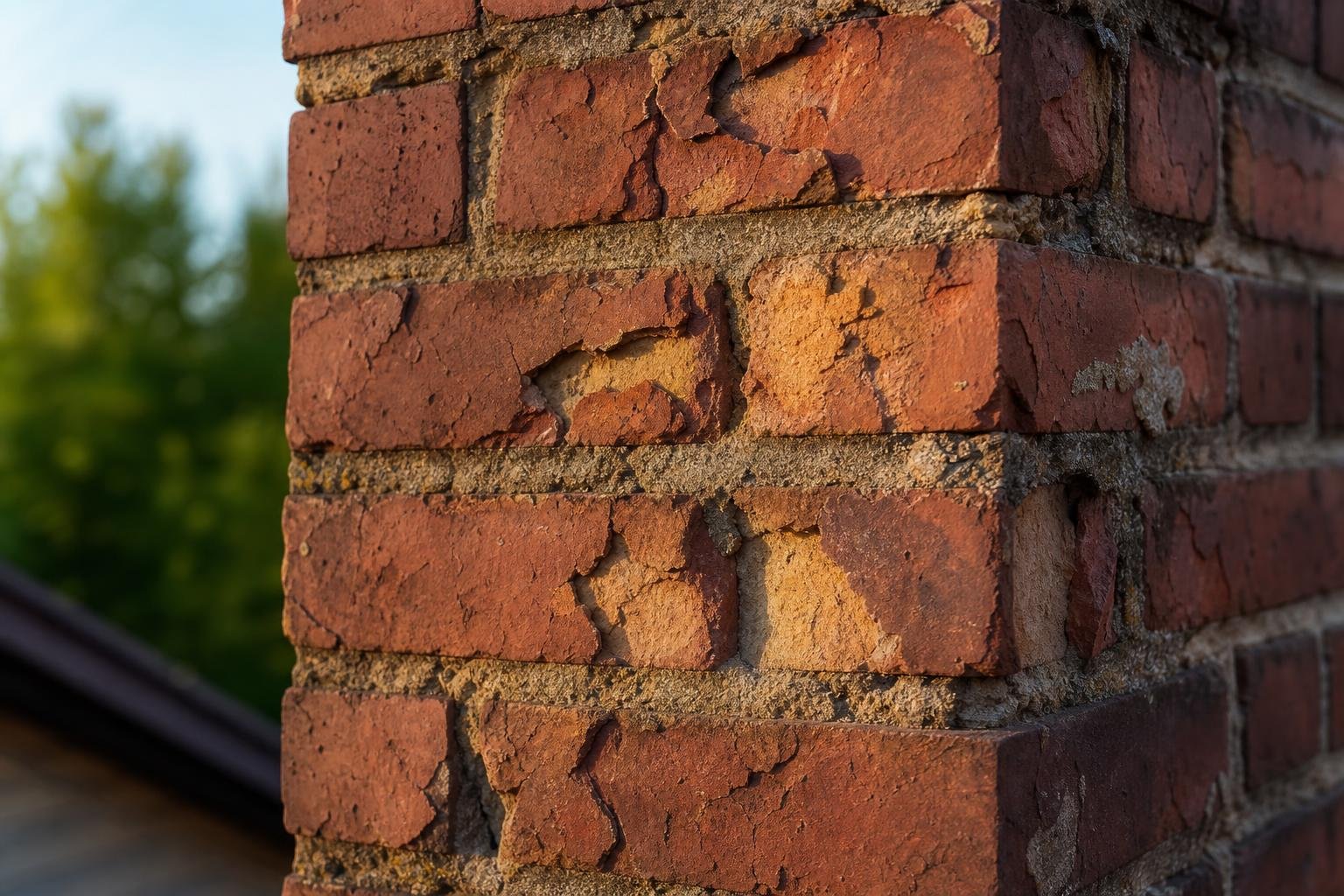
Mortar is the weakest link in any masonry chimney, and it doesn't fail evenly. Sometimes it's a handful of joints on one exposed face of the stack. Other times, especially on older chimneys that have gone years without attention, mortar failure has spread across most of the visible structure, and the brick itself has started cracking or spalling wherever water has worked its way behind the face. Brick repointing, as we scope it, is the answer to that second situation — a full restoration of the mortar joints across large sections or the entire chimney, paired with replacing any individual bricks that are too damaged to leave in place.
It's worth being direct about how this differs from tuckpointing, since the two get used interchangeably and shouldn't be. Tuckpointing is a targeted spot repair — a handful of failed joints, ground out and repacked, while the surrounding brick and mortar are still sound. Brick repointing is a bigger job for chimneys where the deterioration has spread well beyond a few joints: crumbling mortar across most of the courses, multiple bricks with cracked or flaking faces, or water staining that's been getting worse for more than one season. Same underlying skill, very different scope, and we scope it honestly based on what we actually see on your chimney rather than defaulting to either one.
We see extensive mortar failure most often on pre-1970s homes across neighborhoods like Germantown, Sylvan Park, and Lockeland Springs, where original lime-based mortar has simply reached the end of its service life across the whole structure, and on any chimney where the wrong mortar mix was used for Middle Tennessee's freeze-thaw climate.
What's Included in a Brick Repointing Job
- Full-stack evaluation. Assessing every course and face of the chimney to map exactly how far the mortar failure and brick damage extend.
- Large-scale mortar removal. Grinding out failed mortar across the affected sections to a consistent, even depth without damaging sound brick.
- Spalled brick replacement. Swapping out individual bricks that have cracked or flaked, matched as closely as possible to the surrounding brick.
- Written flat-fee estimate. A clear price scoped to the actual extent of the mortar and brick damage, before any work begins.
When Repointing Isn't Enough
Even a large-scale repointing job has its limits. If the chimney is showing signs of leaning, separation from the house, or structural movement, that points to a foundation or framing problem that repointing the brick face won't fix, no matter how thorough the job. In those cases, we'll say so plainly and point you toward a full masonry rebuild assessment instead, rather than repointing a chimney that needs a more structural fix.
Get a Free Repointing Estimate
FAQs
Tuckpointing is a targeted spot repair for a handful of failed mortar joints. Brick repointing, as we scope it, is the larger job: restoring mortar joints across large sections or the entire chimney stack, and it's often paired with replacing individual bricks that have cracked or spalled. If the problem is a few isolated joints, tuckpointing is the right fix. If mortar failure is widespread across the structure, repointing is the more accurate and durable approach.
Signs it's a repointing job rather than a spot repair include mortar that's crumbling or missing across most of the visible stack, several bricks showing cracking or flaking faces, and water staining that's been getting worse over more than one season. When the failure is spread across the structure rather than isolated to a joint or two, a broader repointing job is the more durable and cost-effective route.
Both, when needed. Widespread mortar failure often lets water behind the brick face, which causes individual bricks to crack or spall over time. As part of a repointing job we replace any brick that's too damaged to remain in place, matched as closely as possible to the surrounding brick, alongside repacking the mortar joints.