
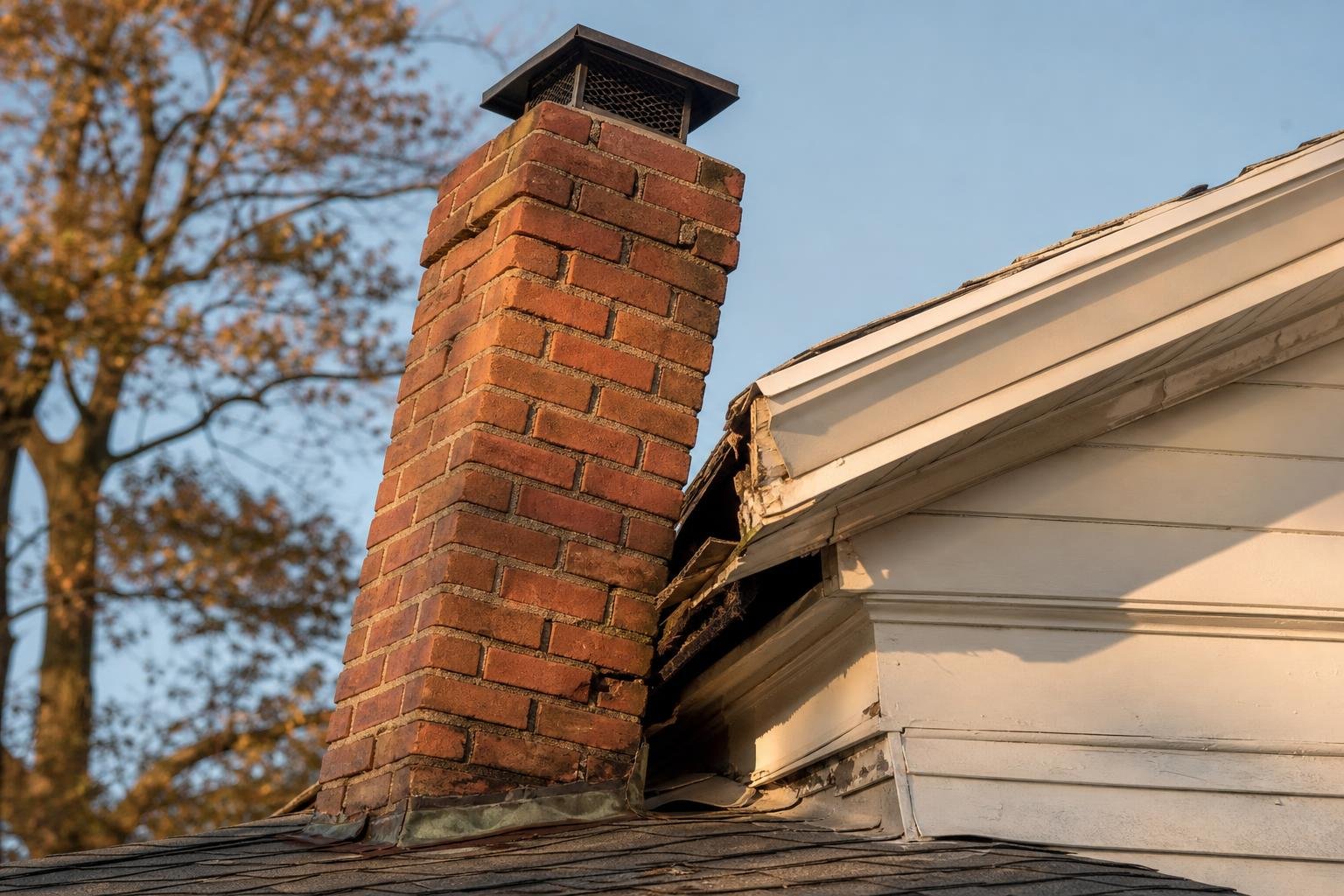
A masonry chimney is one of the heaviest single structures attached to a typical house, often weighing several tons once you account for the brick, the flue, and the footing beneath it. Because of that weight, most chimneys are built on their own separate foundation rather than tying directly into the house's main foundation. That's a sound way to build, but it also means the chimney's footing can settle, shift, or fail on its own timeline, independent of how the rest of the house is doing.
That's the mechanism behind the classic symptom homeowners notice first: a chimney that appears to be leaning away from the house, with a visible gap opening up where the chimney meets the roofline or siding. It's easy to mistake this for a masonry problem, since the visible cracking often shows up in the brick and mortar. But when the underlying cause is a settled or failed footing, repointing or patching the brick won't stop the movement, because the actual problem is structural and below grade, in the soil and footing, not in the masonry surface itself.
Soil conditions around Cleveland and Greater Cleveland — clay-heavy in many neighborhoods, prone to expanding and contracting with moisture swings — make chimney footings especially susceptible to this kind of movement over time, particularly on homes built before modern footing standards were common.
What's Included in a Foundation Assessment & Repair
- Structural evaluation. Assessing the footing, the extent of any lean or separation, and how far the movement has affected the masonry above it.
- Underpinning & stabilization. When the footing has settled but hasn't failed outright, stabilizing it to stop further movement.
- Foundation rebuild, if needed. In more severe cases, rebuilding the footing entirely before any masonry work above it is addressed.
- Written scope & estimate. A clear plan and flat-fee estimate for whichever fix the assessment shows your chimney actually needs.
Underpinning vs. a Full Rebuild: How We Decide
Not every leaning chimney needs to come down. If the footing has settled but the masonry above it is still structurally sound, underpinning and stabilizing the existing foundation can correct the lean and stop further movement without touching the stack itself. But if the footing has failed outright, or the movement has already compromised the brick and mortar above it, a full rebuild starting at the foundation is the safer, more durable fix. This is never a decision we make from the ground — it requires an actual structural assessment, and we'll walk you through exactly what we find before recommending either path.
Request a Foundation Assessment
FAQs
Masonry chimneys are extremely heavy, and on most homes their footing is separate from the main house foundation. That footing can settle or shift independently of the rest of the structure, especially in soil conditions common around Cleveland, which is exactly why a chimney can visibly lean or pull away from an otherwise stable house.
The clearest sign is a visible gap or separation where the chimney meets the house, especially at the roofline, combined with the chimney appearing to lean or tilt away from the structure. Cracked brick or failing mortar can happen on their own, but a widening gap and a visible tilt point to movement in the footing below, not just surface-level masonry damage.
Sometimes. If the footing has settled but the masonry above it is still structurally sound, underpinning and stabilizing the existing foundation can correct the issue without rebuilding the stack. In more severe cases, where the footing has failed or the masonry has been compromised by the movement, a full rebuild starting at the foundation is the safer fix. A structural assessment is what determines which path your chimney needs.