
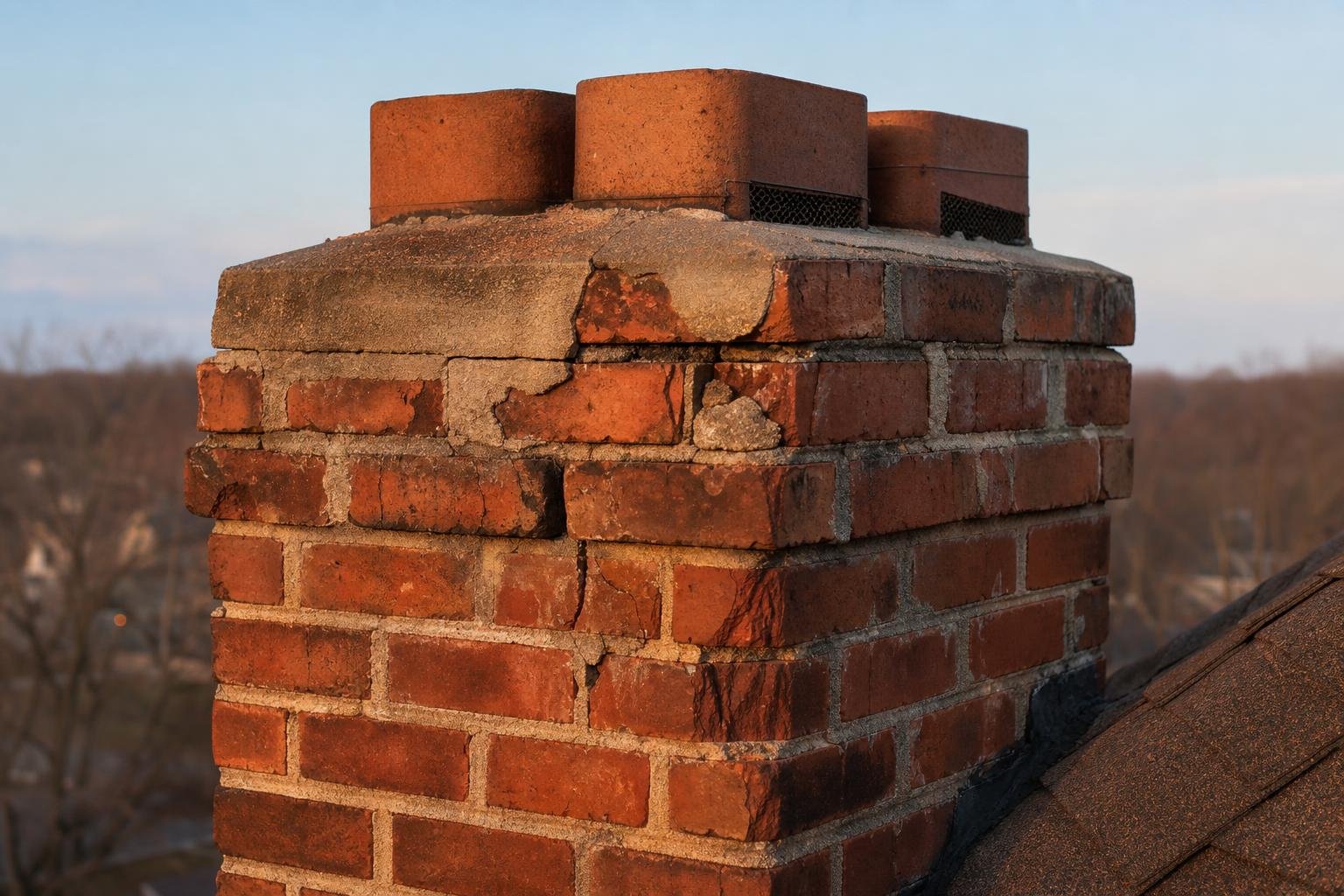
Quick AnswerA chimney crown is the sloped concrete, stone or metal slab that covers the masonry at the top of a chimney and throws water clear of the stack. The building code requires one — IRC R1003.9.1, which calls it a “cap” — and the standard it points to, ASTM C1283, sets four numbers: 2 in. minimum thickness, a 2 in. overhang, a 10-degree slope and a 1½ in. drip slot, plus a bond break at the flue liner. CSIA says most crowns were built from common mortar mix instead. Published repair runs $150 to $1,000 and replacement $1,000 to $3,000 — typical US ranges, not quotes.
What Is a Chimney Crown?
A chimney crown is the sloped slab of concrete, stone or metal that covers the masonry at the very top of a chimney. It seals the top course of brick and the gap around the flue liner, and its slope and overhang throw rain and snowmelt clear of the stack rather than letting it soak in.
It is not decorative and it is not optional. Everything below it — the brick, the mortar joints, the flue liner, the damper, the firebox — is protected by a slab that is typically two to four inches thick and, on most chimneys, has never been looked at. CSIA puts the job of the crown in one sentence: “The crown should provide a downward slope that will direct the water from the flue to the edge of the crown.”
Two things follow from that. A crown that is flat does not do its job, and a crown that stops at the edge of the brick instead of hanging past it does not either, because water running off it lands straight on the masonry face. Both faults are visible from the ground with a phone camera at full zoom, and both are the reason a stack starts shedding brick faces a decade early.
Chimney Crown vs Chimney Cap vs Chimney Chase Cover: Which Is Which?
The crown is the masonry slab across the whole top of the chimney. The cap is the metal hood with mesh sides sitting over the flue opening. The chimney chase cover is the sheet-metal lid on a framed, prefabricated chimney. Three different parts, three different prices, and the code calls the crown a cap.
That last point is not a quibble. Section R1003.9.1 of the International Residential Code is headed Chimney caps and requires “a concrete, metal or stone cap” — which is the slab the trade calls a crown, not the mesh hood a homeowner pictures. So a contractor can tell you truthfully that the code requires a cap and mean the thing you thought was already there.
The money follows the confusion. Fixr prices a cap replacement at $300 to $600 and a crown replacement at $1,000 to $3,000; Angi puts a cap at around $300 and notes caps are far more affordable than crown work. Mixing up the two words is a three- to ten-fold difference on a quote, so it is worth settling which part of the chimney is being discussed before anything else.
| Part | What it is | Usual material | Published replacement range | How it typically fails |
|---|---|---|---|---|
| Crown (the code says “cap”) | The sloped slab covering the entire top of the masonry | Cast concrete, precast concrete or stone | $1,000 to $3,000 (HomeGuide, Fixr, This Old House) | Cracks radiating from the flue; loss of slope or overhang |
| Cap (also rain cap, spark arrestor) | The metal hood with mesh sides over the flue opening | Stainless steel, galvanised steel or copper | $300 to $600 (Fixr); around $300 average (Angi) | Rust-through, storm damage, missing after wind |
| Chimney chase cover | The flat sheet-metal lid on a framed prefabricated chase | Galvanised steel, stainless steel or aluminium | $300 to $700 (Fixr) | Rust and ponding water where the metal has no slope |
If what you are actually after is the metal hood rather than the slab, our guides to chimney cap replacement cost and whether you need a chimney cap at all cover that part instead.
What Does the Building Code Require of a Chimney Crown?
A crown is required, and the code states it in one sentence. IRC section R1003.9.1 reads: “Masonry chimneys shall have a concrete, metal or stone cap, a drip edge and a caulked bond break around any flue liners in accordance with ASTM C1283. The concrete, metal or stone cap shall be sloped to shed water.”
Notice what the code itself does not give you: a thickness, a slope angle, an overhang or a drip dimension. All four live in the referenced standard, ASTM C1283, which is why almost no homeowner-facing page carries them. Section 8 of that standard requires a slope of at least 10 degrees down from the flue liner to the edge, an overhang of at least 2 inches past the chimney wall, a cast or precast concrete cap at least 2 inches thick reinforced with half-inch galvanized hardware cloth set halfway into the form, and a drip slot on the underside at least 1½ inches clear of the wall.
Section 8.4 adds the detail that decides whether the slab survives: the cap “shall be separated from the flue lining by a bond break”, sealed with a non-combustible resilient sealant. Concrete and clay expand at different rates when a fire is lit. Without that joint, the flue liner levers the slab apart from the inside, which is exactly where cracked crowns crack.
| Requirement | The number | Why it exists | What it looks like when it is missing |
|---|---|---|---|
| Thickness (cast, precast or stone) | Not less than 2 in. (51 mm) | Enough section to span the brick and resist cracking | A thin mortar wash a half-inch deep, cracked through |
| Overhang past the chimney wall | Not less than 2 in. (51 mm) | Throws runoff clear of the brick face | A slab flush with the brick, with staining down the stack |
| Slope from flue liner to edge | Not less than 10 degrees | Moves water off rather than letting it pool | A flat top holding puddles and ice |
| Drip slot on the underside | At least 1½ in. (38 mm) clear of the wall | Breaks surface tension so water drops rather than tracking back | Water curling under the overhang onto the brick |
| Reinforcement | ½ in. (13 mm) galvanized mesh at mid-depth | Holds the slab together once it does crack | Pieces of crown that lift off by hand |
| Bond break at the flue liner | A sealed, resilient joint | Lets concrete and clay move at different rates | Cracks radiating outward from the liner |
One more code number is worth having, because it is the one homeowners argue with contractors about: R1003.9 requires a chimney to terminate “not less than 2 feet (610 mm) higher than any portion of a building within 10 feet (3048 mm)” and “not less than 3 feet (914 mm) above the highest point where the chimney passes through the roof”. If a crown rebuild means taking the stack down a few courses, that clearance is what it has to be rebuilt back up to. Local amendments vary.
Why Do So Many Chimney Crowns Crack?
Because most were never built to that specification. CSIA says it without hedging: “Most masonry chimneys are built with an inadequate crown constructed from common mortar mix”, when “a proper chimney crown should be constructed of a Portland cement-based mixture.”
Mortar and concrete are not the same material. Mortar is formulated to bond brick, stay workable and give slightly under load; it is weaker in tension, has little aggregate and is never reinforced. Spread two inches of it across the top of a stack with the flue liner cast rigidly into the middle and no joint between them, and it will crack. Not might — will, usually within a few winters.
Then the climate finishes the job. CSIA describes the mechanism: “Masonry materials deteriorate quickly when exposed to the freeze/thaw process”, in which “moisture that has penetrated the materials periodically freezes and expands causing undue stress.” A hairline crack admits water, the water freezes, the crack widens, and the next cycle admits more. In Minneapolis or Cleveland that loop runs through a good part of the year, which is why a crown that stays a nuisance in a mild climate becomes a rebuild in a cold one.
How Do You Know a Chimney Crown Needs Attention?
Most of it checks from the ground with binoculars or a phone at full zoom. You are looking for cracks radiating out from the flue liner, a slab sitting flush with the brick rather than hanging past it, no visible slope, spalling brick in the top courses, and rust staining.
One more item belongs on that list and is the easiest of the lot to check: whether the flue liner stands proud of the slab at all.
That last one is a specification rather than an opinion. CSIA requires that “the flue liner tile should also project above the crown a minimum of two inches” and that the overhang project “beyond all sides of the chimney by a minimum of two inches.” Two measurements, both sightable from a driveway, and either one failing tells you the crown was not built to standard regardless of how tidy it looks.
Inside the house the symptoms arrive later and read as something else: damp patches on the chimney breast, a musty smell in the firebox, rust on the damper or the firebox panels, or white efflorescence blooming on the brick. CSIA notes that “water in the chimney also causes rust in steel and cast iron, weakening or destroying the metal parts”, and that “when water mixes with creosote in a wood burning chimney system, it will generate a highly disagreeable odor.” If the smell arrived before the stain did, the water has been getting in for a while.
How Much Does Chimney Crown Repair Cost?
Published repair ranges run from $150 to $1,000, and which end you read depends entirely on the publisher. Angi puts minor crown repair at $150 to $350, HomeGuide at $200 to $700, and Fixr and This Old House both at $750 to $1,000. Typical US ranges, not a quote.
Around those figures sit the costs that do not appear in the crown row and show up on the invoice anyway. Labour runs $50 to $200 an hour at HomeGuide and $50 to $150 at both Fixr and This Old House, with Fixr and This Old House also naming a minimum service fee of $50 to $100. Fixr adds $50 to $200 for scaffolding and $100 to $300 for emergency service; HomeGuide and Angi both put emergency labour as high as $300 an hour.
Height is the variable that moves a crown price more than the crown itself. A single-storey ranch with a short stack reachable from a ladder is a different job from a steep-pitch two-storey where the crew needs staging before anyone touches a trowel, and that difference lands on the scaffolding line rather than the materials line.
| Publisher | Data date | Crown repair | Crown replacement | Labour | Other published rates |
|---|---|---|---|---|---|
| HomeGuide | 22 January 2026 | $200 to $700 (minor repairs) | $1,000 to $3,000 | $50 to $200/hr; up to $300/hr emergency | Sealing and waterproofing $150 to $820+; leak sealing $150 to $500; flue tile repair $65 to $100/sq ft |
| Angi | 6 October 2026 | $150 to $350 (minor damage) | Can reach $3,000 | Up to $300/hr emergency | Cap replacement around $300; sealing $150 to $500; tuckpointing $500 to $2,500; parging $1,000 to $2,000; full chimney replacement $10,000 to $15,000 |
| Fixr | 31 January 2025 | $750 to $1,000 | $1,000 to $3,000 | $50 to $150/hr; $50 to $100 minimum fee | Cap repair $100 to $250; cap replacement $300 to $600; chimney chase cover replacement $300 to $700; liner replacement $1,200 to $4,600; spalling $1,000 to $2,500; leaning $1,500 to $3,500 |
| This Old House | 12 March 2026 | $750 to $1,000 | $1,000 to $3,000 | $50 to $150/hr; $50 to $100 service call | Chimney repair average about $750, overall range $250 to $13,300; sealing $150 to $500 |
How Much Does Chimney Crown Replacement Cost?
$1,000 to $3,000. HomeGuide, Fixr and This Old House each publish exactly that range for a full crown replacement, and Angi says replacement can reach $3,000. It is the one crown figure the publishers agree on, which makes it the most defensible number on this page — a typical US range, not a quote.
What that buys is a demolition and a pour: the old slab broken out, the top courses of brick checked and repaired where water got in, forms built around the stack, an isolation joint wrapped around the flue liner, mesh laid at mid-depth, concrete placed and screeded to a slope, and a drip slot formed into the underside of the overhang before it cures. The pour itself is a morning. The access, the cure and the weather window are what make it a day or more.
The figure moves on stack size more than anything else, because a crown is priced by area and a four-flue chimney on an older house can be several times the slab of a single-flue stack. Fixr sets the wider frame: chimney work it classes as a rebuild runs $500 to $4,000 and a full chimney replacement $4,000 to $8,000, against Angi’s $10,000 to $15,000. A crown at $1,000 to $3,000 is the cheap end of that scale, and it is the repair that keeps the expensive ones away.
Why Do Published Chimney Crown Prices Disagree So Much?
Because “crown repair” names three different jobs. A sealant application, a crack patch and a poured overlay get priced in the same table row by publishers who never say which they mean. Fixr’s floor of $750 sits above HomeGuide’s ceiling of $700, and that is a scope gap, not a price gap.
Two other things are going on. Angi and HomeGuide both qualify their figures with the word minor — Angi’s $150 to $350 is explicitly for minor damage, HomeGuide’s $200 to $700 is for minor crown repairs — while Fixr and This Old House attach no such qualifier to $750 to $1,000. And Fixr and This Old House publish identical crown figures in both rows, which means the four publishers here are really three positions, not four.
So the useful question is not what a crown repair costs but which of the three jobs is being quoted. Three questions settle it: are you sealing the surface, patching cracks, or pouring a new slab; will the new slab overhang the brick by two inches; and is an isolation joint going in around the flue liner. A quote that answers all three can be compared with another quote. One that says “crown repair” and a number cannot.
Should a Chimney Crown Be Repaired or Replaced?
The dividing line is shape, not surface. If the slab is thick enough, sloped and overhanging the brick with a drip underneath, then cracks in it are a surface problem and sealing or patching is honest work. If the shape is wrong, no coating fixes it.
That is the whole test, and the reason it works is that a crown of the wrong shape was never throwing water clear of the brick in the first place. Coating it seals a surface that was not the problem.
| What you can see | Which way it points | Why |
|---|---|---|
| Hairline cracks, slab otherwise sloped and overhanging | Seal or patch — $150 to $700 | The geometry works; the surface needs bridging before water gets in |
| Cracks wide enough to take a fingernail, radiating from the flue | Patch or resurface — $200 to $1,000 | Usually a missing bond break; worth fixing before the pieces start to move |
| Slab flush with the brick, no overhang | Replace — $1,000 to $3,000 | Runoff lands on the masonry face; coating it changes nothing |
| Flat top holding water or ice | Replace — $1,000 to $3,000 | No slope means standing water and a freeze-thaw cycle every cold night |
| Pieces loose or liftable by hand | Replace — $1,000 to $3,000 | Unreinforced and already failed; a patch has nothing sound to bond to |
| Spalling brick in the top courses as well as a cracked crown | Replace, plus masonry repair — crown $1,000 to $3,000 on top of tuckpointing at $500 to $2,500 or spalling repair at $1,000 to $2,500 | Water has been getting in long enough to damage what the crown sits on |
Where the brick below has suffered as well, our guide to tuckpointing covers the mortar side of that repair and the mortar-strength rule that decides whether it lasts.
Do Chimney Crown Sealers Actually Work?
On a sound crown with hairline cracks, yes. A brushable elastomeric crown sealant bridges the cracks and buys years at the $150 to $500 that Angi, Fixr and This Old House all publish for sealing work. On a crown that has broken into pieces, no.
The limit is the one from the section above: where a crown never had an overhang, the fault is its shape, and a coating does not change shape.
The product matters, and CSIA is unusually direct about it. Masonry waterproofing formulas “are 100% vapor permeable, which means that they allow the chimney to breathe”, and “paint or clear sealers should never be used as a waterproofing agent” because “they will trap water vapors and moisture inside the chimney causing further deterioration.” A chimney that has been painted at the top is in worse shape than one left bare.
Two more points from the same source set expectations honestly. These products “usually have a five- to ten-year warranty”, so sealing is a maintenance cycle rather than a permanent fix. And “waterproofing is a preventive measure” in which “the chimney should be repaired before the waterproofing agent is applied” — sealing a crown that needs rebuilding seals the damage in rather than out.
How Is a Chimney Crown Repaired or Rebuilt?
A repair is a surface job: the crown is cleaned, loose material removed, cracks opened slightly and filled, and a flexible crown coating brushed over the whole slab and lapped slightly down the brick. A rebuild is a demolition and a pour, and the sequence is where the four code numbers earn their place.
On a rebuild the old slab comes off, the top courses of brick get inspected and repointed where water has already worked in, and the flue liner is checked for the two inches it should be standing proud. Forms go up around the stack set out to give a two-inch overhang. A compressible isolation material wraps the liner so the concrete never bonds to it. Galvanized mesh is laid at mid-depth, concrete is placed and screeded to at least a ten-degree fall, a drip slot is formed into the underside, and the joint at the liner is finished with a resilient non-combustible sealant.
The honest question to ask a contractor is the one about the slot and the joint, because those two details cost almost nothing and are the first things to disappear from a cheap pour. A crown with a two-inch overhang but no drip slot sheds water back onto the brick anyway, and a crown without a bond break cracks on schedule.
Can You Repair a Chimney Crown Yourself?
Brushing a sealant onto hairline cracks is within reach for someone already comfortable working on a roof. Pouring a new crown is not. It needs formwork set out to a measured overhang, an isolation joint around the flue liner, mesh at mid-depth, a screeded slope and a drip slot formed into the underside before the concrete sets.
The failure mode of a do-it-yourself crown is specific and common: a bag of mortar mixed stiff, troweled over the top, feathered out to the brick edge with no overhang, no mesh and no joint at the liner. That is a crown that looks finished, reads as repaired on a disclosure form, and cracks in the first hard winter — and because it has bonded to the old slab, the next contractor has more to break out than they would have had.
The cost comparison is the honest argument against it. A sealant job a homeowner might do themselves is published at $150 to $500 done professionally, which is a narrow saving for roof work. A crown replacement at $1,000 to $3,000 is not a saving at all once the forms, concrete, mesh, sealant and a day of exposure on a pitched roof are priced in.
What Does a Failed Crown Cost If You Leave It?
The crown is the cheapest repair at the top of a chimney and the one that gates the expensive ones. Published figures for what follows water getting in: spalling brick repair $1,000 to $2,500, tuckpointing $500 to $2,500, parging $1,000 to $2,000, liner replacement $1,200 to $4,600, a leaning stack $1,500 to $3,500.
Those sit against a crown replacement of $1,000 to $3,000, and they are not alternatives to it — they are what gets added to it, because a new crown over damaged brick still needs the brick fixed. Angi’s figure for a full chimney replacement, $10,000 to $15,000, is the end of that road; Fixr puts the same job at $4,000 to $8,000.
The insurance picture frames the risk in another currency. Water damage and freezing accounted for 22.6 percent of all US homeowners insurance losses in 2023, according to Triple-I citing ISO, a Verisk Analytics business, second only to wind and hail at 42.5 percent, and it has been between 19.8 and 28.7 percent every year from 2019 to 2023. Average claim severity in that category was $15,400 across those five years at 1.50 claims per 100 house years. Against a $1,000 to $3,000 crown, that average claim is roughly five to fifteen times the repair — our arithmetic on Triple-I’s published average and the publishers’ published ranges, not a figure either source states.
Does a New Crown Stop a Chimney Leak?
Only if the crown was the entry point. Water gets into a chimney through four places — the crown, the cap, the flashing where the stack meets the roof, and the masonry itself — and the stain on a ceiling is often fed from a different one than the obvious one. Tracing the path comes before buying a slab.
The masonry route is the one people discount. CSIA notes that “most masonry materials are porous and will absorb large amounts of water” and that “common brick is like a sponge, absorbing water and wicking moisture to the chimney interior”, which means a perfect crown on an unwaterproofed stack can still deliver damp to the chimney breast. The flue opening matters too: CSIA points out that “a commonly-sized flue has the potential to allow large amounts of rain or snow into the chimney”, which is the cap’s job rather than the crown’s.
In practice a competent diagnosis works down from the top in that order, and often finds two faults rather than one. Our guide to chimney flashing and leaks covers the roofline joint, and chimney liner cost and types covers what happens when water has already been working on the flue.
How Long Should a Chimney Crown Last?
None of the four publishers checked for this page publishes a lifespan for a chimney crown, which is worth knowing before anyone quotes you one. The nearest published figures are adjacent: Fixr puts mortar at 20 to 30 years, and CSIA says masonry waterproofing products “usually have a five- to ten-year warranty.”
What the standards imply is a longer answer than the market delivers. A crown built to ASTM C1283 — two inches of reinforced concrete, sloped, overhanging, isolated from the liner — is a structural element with no obvious wear mechanism beyond freeze-thaw on its surface. A crown built from leftover mortar wash with the liner cast into it has a failure built in from the day it cured. That is the gap between a crown that outlasts a roof and one that cracks in five years, and it is decided at the pour.
We have deliberately not invented a number here. If a contractor offers you a crown lifespan, the useful follow-up is which of those two crowns they are quoting, and whether the overhang, the mesh and the bond break are in the price.
When Should a Chimney Crown Be Inspected?
At least once a year, and it is already in scope. NFPA 211 requires, as CSIA quotes it, that “chimneys, fireplaces, and vents shall be inspected at least once a year for soundness, freedom from deposits, and correct clearances.” The crown is part of that soundness check.
That makes the annual visit the cheapest moment in the year to find out whether the crown has another decade in it. A Level 1 inspection covers the readily accessible portions of the chimney, and the crown is one of them; a hairline crack caught at a sweep becomes a $150 to $500 sealing job rather than a $1,000 to $3,000 replacement plus the masonry repair underneath it.
Our guide to chimney inspection cost and what each level includes sets out what is examined at each of the three NFPA 211 levels and when each one is required, including the Level 2 that a property sale triggers — where a cracked crown has a habit of appearing on an inspection report at the worst possible moment.
Chimney Crown Questions? Your Local Team
If you are in or around Nashville, Cincinnati, Cleveland or Minneapolis, our technicians will tell you whether the crown is the actual entry point or whether the water is arriving from the cap, the flashing or the brick itself, measure the overhang and the flue projection rather than eyeballing them, say plainly whether the slab needs repair or a full rebuild, and quote the drip slot and the bond break as part of the work rather than as extras — with a flat fee in writing before anything is broken out. Choose your city below for local details and booking.
Nashville, TN · Cincinnati, OH · Cleveland, OH · Minneapolis, MN
FAQs
A chimney crown is the sloped slab of concrete, stone or metal that covers the masonry at the very top of a chimney. It seals the top course of brick and the gap around the flue liner, and its slope and overhang throw rain and snowmelt clear of the stack instead of letting it soak in.
The crown is the masonry slab across the whole top of the chimney. The cap is the metal hood with mesh sides that sits over the flue opening to keep out rain, animals and sparks. Confusingly, the International Residential Code uses the word cap for what the trade calls the crown.
Published ranges run from $150 to $1,000. Angi puts minor crown repair at $150 to $350, HomeGuide at $200 to $700, and Fixr and This Old House both at $750 to $1,000. The spread is a scope difference rather than a price difference: sealing, patching and resurfacing are three different jobs. These are typical US ranges, not a quote.
$1,000 to $3,000. HomeGuide, Fixr and This Old House each publish exactly that range for a full crown replacement, and Angi says replacement can reach $3,000. It is the one crown figure the publishers agree on. That is a typical US range, not a quote; height, access and stack size move it.
At least 2 inches. ASTM C1283, the standard the International Residential Code points to in section R1003.9.1, requires precast or cast-in-place concrete caps to be a minimum of 2 inches thick, reinforced with half-inch galvanized mesh set halfway into the form. Stone caps carry the same 2-inch minimum.
Sometimes. A brushable elastomeric crown sealant will bridge hairline cracks on a crown that is otherwise sound, properly sloped and overhanging the brick. It will not rescue a crown that has broken into pieces, lost its overhang or was poured flush with the masonry, because the fault there is the shape, not the surface.
None of the four price publishers checked for this page publishes a lifespan for a chimney crown, which is worth knowing before anyone quotes you one. What is published: mortar generally lasts 20 to 30 years, and CSIA says masonry waterproofing products usually carry a five to ten year warranty.
Brushing a sealant onto hairline cracks is within reach for someone already comfortable on a roof. Pouring a new crown is not. It needs formwork, an isolation joint around the flue liner, mesh reinforcement set at mid-depth, a measured slope and a drip slot cut into the underside of the overhang.
It is one of four common entry points, alongside the cap, the flashing at the roofline and the masonry itself. A crown crack lets water straight into the top of the stack and into the gap beside the flue, so it is worth ruling in or out first, but the stain inside is often fed from somewhere else.
Sources and Standards Cited
Every dollar figure on this page is a published national range, with the publisher and its own data date named inline. They are typical US ranges, not our quotes. The code text is the 2021 International Residential Code as adopted and published by the City of Seattle, because the ICC’s own full text is paywalled; local amendments vary. The crown dimensions are ASTM C1283’s, cited through a published quotation of that standard rather than from the standard itself, which is paywalled and stated as such below.
- 2021 International Residential Code, Chapter 10, as adopted and published by the City of Seattle (SDCI) — R1003.9.1, “Masonry chimneys shall have a concrete, metal or stone cap, a drip edge and a caulked bond break around any flue liners in accordance with ASTM C1283. The concrete, metal or stone cap shall be sloped to shed water”; R1003.9 termination at “not less than 2 feet (610 mm) higher than any portion of a building within 10 feet (3048 mm)” and “not less than 3 feet (914 mm) above the highest point where the chimney passes through the roof”; R1003.10 chimney wall thickness of “not less than a 4-inch (102 mm) nominal thickness”. None of the sections quoted here carries a [W] Washington amendment marker; local amendments elsewhere do vary. Note that the code gives the crown no thickness, slope, overhang or drip dimension of its own — all four are in the referenced ASTM standard.
- ASTM C1283, Standard Practice for Installing Clay Flue Lining — cited here through Rumford Fireplace’s published quotation of its Section 8, “Chimney Caps”: a slope “a minimum of 10 degrees downward from the flue liner to the edge of the chimney cap” (8.1); “Chimney caps shall overhang the chimney wall by a minimum of 2 in. (51 mm)” (8.2); precast or cast-in-place concrete caps “a minimum of 2 in. (51 mm) in thickness”, “reinforced with a minimum of 1/2 in. (13 mm) mesh galvanized hardware cloth located halfway into the filled form” and with “a drip slot on the underside at least 1 1/2 in. (38 mm) away from the chimney wall” (8.3.1), with stone caps carrying the same 2 in. thickness and drip-slot requirements (8.3.3); and caps that “shall be separated from the flue lining by a bond break” sealed with a non-combustible resilient sealant (8.4). The standard itself is paywalled and was not read for this page; nothing beyond the Section 8 requirements quoted above is attributed to it.
- Chimney Safety Institute of America, Water and Masonry — “The crown should provide a downward slope that will direct the water from the flue to the edge of the crown”; “Most masonry chimneys are built with an inadequate crown constructed from common mortar mix” against “a proper chimney crown should be constructed of a Portland cement-based mixture”; “an overhang projecting beyond all sides of the chimney by a minimum of two inches” and “the flue liner tile should also project above the crown a minimum of two inches”; “masonry materials deteriorate quickly when exposed to the freeze/thaw process” where “moisture that has penetrated the materials periodically freezes and expands causing undue stress”; “water in the chimney also causes rust in steel and cast iron, weakening or destroying the metal parts”; “when water mixes with creosote in a wood burning chimney system, it will generate a highly disagreeable odor”; “a commonly-sized flue has the potential to allow large amounts of rain or snow into the chimney”; “most masonry materials are porous and will absorb large amounts of water” and “common brick is like a sponge, absorbing water and wicking moisture to the chimney interior”; waterproofing formulas “100% vapor permeable” with “a five- to ten-year warranty”; “paint or clear sealers should never be used as a waterproofing agent” because “they will trap water vapors and moisture inside the chimney causing further deterioration”; “waterproofing is a preventive measure” and “the chimney should be repaired before the waterproofing agent is applied”.
- NFPA 211, Standard for Chimneys, Fireplaces, Vents, and Solid Fuel-Burning Appliances — the at-least-annual inspection, quoted here as CSIA states it: “Chimneys, fireplaces, and vents shall be inspected at least once a year for soundness, freedom from deposits, and correct clearances”. The standard itself is paywalled; nothing beyond that requirement is attributed to it here.
- HomeGuide, How Much Does Chimney Repair Cost, written 22 January 2026 — “Minor chimney crown repairs cost $200 to $700”; crown replacement $1,000 to $3,000, with the text giving a ceiling of up to $3,000 for replacing an entire crown; the crown described as a concrete slab beneath the cap; sealing and waterproofing $150 to $820+, with leak sealing $150 to $500 and complete waterproofing reaching $800+; flue tile repair $65 to $100 per square foot; labour $50 to $200 per hour and up to $300 per hour for emergency repairs.
- Angi, How Much Does Chimney Repair Cost, last updated 6 October 2026 — “Repairing a chimney crown costs between $150 and $350 for minor damage”, with full replacement for extensive cracking or water damage reaching $3,000; chimney cap replacement averaging $300 and caps noted as far more affordable than crown work; sealing $150 to $500; wood rot $100 to $300; tuckpointing $500 to $2,500; parging $1,000 to $2,000; flue repair $65 to $100 per square foot; repointing $4 to $25 per square foot; full chimney replacement $10,000 to $15,000; emergency labour reaching $300 per hour, with roof height and pitch raising labour costs and a lower per-square-foot rate where the chimney top is reachable by ladder.
- Fixr, How Much Does It Cost to Repair a Chimney, last updated 31 January 2025 — crown repair $750 to $1,000 and crown replacement $1,000 to $3,000, both labour included; common crown repairs described as sealant applications and crack patching, with no separate price for either; national average $750 within a typical $250 to $1,200; cap repair $100 to $250 and cap replacement $300 to $600; chimney chase cover replacement $300 to $700; flashing replacement $300 to $800; liner replacement $1,200 to $4,600; flue replacement $3,000 to $7,000; spalling $1,000 to $2,500; leaning $1,500 to $3,500; sealing $150 to $500; rebuild $500 to $4,000; parging $1,000 to $2,000; full chimney replacement $4,000 to $8,000; labour $50 to $150 per hour with a $50 to $100 minimum fee, scaffolding adding $50 to $200 and emergency service $100 to $300; mortar lasting 20 to 30 years. This is the oldest cost source on the page and is named as such wherever it is used.
- This Old House, Chimney Repair Cost, last updated 12 March 2026 — crown repair $750 to $1,000 and crown replacement $1,000 to $3,000; chimney repair average of about $750 within an overall $250 to $13,300; sealing $150 to $500; labour $50 to $150 per hour with a flat service call fee of $50 to $100. Its crown figures are identical to Fixr’s in both rows, so the two are treated on this page as one position rather than two independent sources.
- Insurance Information Institute (Triple-I), Facts + Statistics: Homeowners and renters insurance, citing ISO, a Verisk Analytics business — water damage and freezing at 22.6 percent of US homeowners insurance losses in 2023, second to wind and hail at 42.5 percent, within a 2019 to 2023 series of 28.7, 19.8, 23.7, 25.8 and 22.6 percent; average claim severity for water damage and freezing of $15,400 across 2019 to 2023 at 1.50 claims per 100 house years. The comparison against crown replacement cost on this page is our own arithmetic on those published figures, not a figure Triple-I states.